You know my predicament: I am passionate about writing but I also love teaching. Beyond loving my decades-long professional commitment, I am having to allocate most of my time to its demands. The new semester is coming to a fast end but in an immensely time-consuming manner. I find it more and more difficult in this final month to reserve their deserved time aside for my Sunday reflections – to do any qualitative research on some issues of larger interest to us all, that is. I hope you won’t mind terribly, if I were to share with you one of my new poems for the end of each of the next few weeks. What I would very much appreciate from you is, any few minutes you may be able to set aside to comment on each poetic construct. If that were to be too much to ask, then, perhaps you would be willing to suggest a title for a larger writing project I have in mind in which to collect all these poems. In case you have an active account on facebook, some of them will appear familiar to you, as I have posted them on my page and/or timeline on that platform. What I have conceived so far for the project in question is in line with my core existential determinant – as I articulated it in my debut book:
“Love and melancholy. Two traits that defined me throughout my life thus far. Not very different from Oğuz Ozdeş’ Hülya – the young woman whose tragic love captivated my mother to the extent that she adopted her name for me. As I have said before, I have a commitment to love. When it comes to melancholy, I am considering a healing interaction with it – an initiative I have already prompted with my poems for Trance. I do intend to accomplish a continued healing, though. To begin to achieve such endeavor, I may have to write a different ending to Hülya but to hülya as well. And, I believe I will (from: Preface, Trance, a collection of poems in English, German and Turkish).”
I very much look forward to your comment and your next visit. May the rest of your day and new week be filled with joyous events and interactions.
~ ~ ~ ~ ~ ~ ~ ~ ~
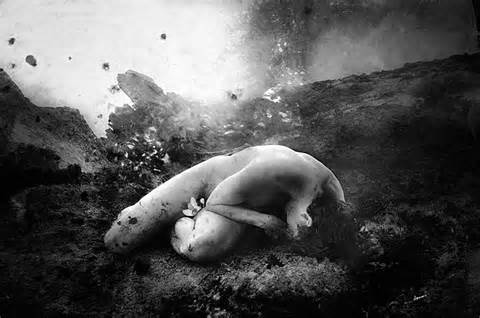
do you think back
to remember it all
how i lain on the mossy ground
blanketed myself with your scent
the quiet creek of our first encounter
encircling the rays of an afternoon sun
how it slowed its path to honor our euphoric reunion
to watch us flow into one another – learned and approved…
wind and air however envied pulled their forces together
thus came an end in a lightning – fiercely brash
my graceful i kept at bay its dire hope to let you float
what ifs of our dread are adamant in haunting me yet
[Image Credit: James Wolf and Gyöngyi Keller of facebook]
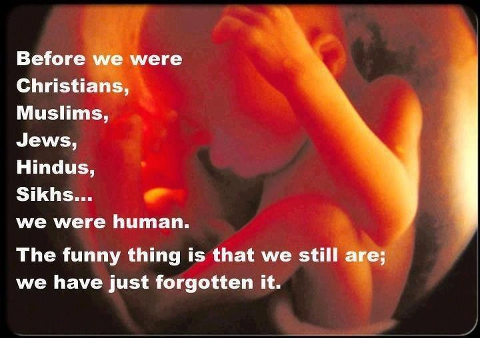
Yes, I am intentionally personalizing any and all religious institutions. And yes, I am intentionally using a mere clause – and a dependent one, at that; instead of a complete sentence statement. Because I am hoping you will help me with potential independent clauses that may enable us to conceptualize anew the practice of “religion” in the terms with which I open a discussion floor to us: When the application of any world religion’s teachings disregards or discards love for another human being, …
~ ~ ~ ~ ~ ~ ~ ~ ~
May you have a spectacular Sunday and a fabulous week. As always, I very much look forward to your visit.
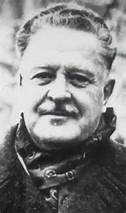
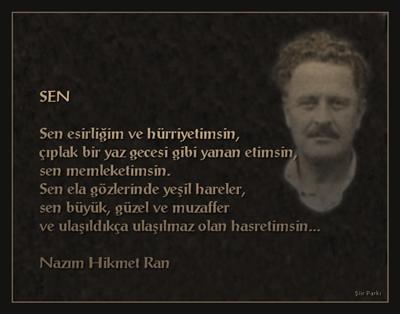
At times, we believe what we want to believe, don’t we? Similarly, we refuse to believe what others may claim? Such as an attribute given to a well-known poet? Just like I do, with Nazım (I don’t even want to refer to him with his full name – it feels so very alien and impersonal…), the world-renowned Turkish exile poet. I never believed he was a traitor, as claimed by some officials of Turkey in the past (there was a retraction of such claims after Nazım’s death), nor a womanizer (but a lover of love, one woman at a time). When this most influential writer died (on exile, craving to be in his country of birth), I was a mere eight year-old. My passionate engagement with his poetry and other writings have everything to do with the development and intensification of my own interest. Not because of schooling on his persona and work, or parental introduction (on the contrary: I believe my father was also under the negative influence of one of Turkey’s population segment; my mother always remained neutral – she wouldn’t comment at all, I suspected she, too, liked him outside the norm…). The more I actively read Nazım’s written word, the more drawn I became to everything he stood for. Let’s call him my very first crush, okay? Incredibly handsome, a stellar composer of poetry, the center of attention of the entire country – for this or that reason, immensely influential nationally as well as abroad: a timeless love, to admit. For today, I have for us two examples from his poetry – not at all the most frequently cited ones, by the way. Both works address his love for which he was known to have possessed an extraordinary passion: one, to a woman (“Ben senden önce ölmek isterim”, “I want to die before you”); the other (“Sen”, “You”), to Turkey, his country of birth – one among his numerous poems of homesickness. It is not any time of anniversary for Nazım. I am reminiscing him simply because during most of my awake times, he is in my heart and mind. For, at this stage in my life, I finally am aware more of his value for and contributions to world literature – a subject matter of my special interest as far as my professional undertaking. I hope you will enjoy this short journey in to a glorious past of the Turkish civilization of contemporary times – an aspect of the country that today is fading away fast and under the harshest possible forces.
Ben senden önce ölmek isterim. Gidenin arkasından gelen gideni bulacak mı zannediyorsun? Ben zannetmiyorum bunu. İyisi mi, beni yaktırırsın, odanda ocağın üstüne korsun içinde bir kavanozun. Kavanoz camdan olsun, şeffaf, beyaz camdan olsun ki içinde beni görebilesin… Fedakârlığımı anlıyorsun : vazgeçtim toprak olmaktan, vazgeçtim çiçek olmaktan senin yanında kalabilmek için. Ve toz oluyorum yaşıyorum yanında senin. Sonra, sen de ölünce kavanozuma gelirsin. Ve orda beraber yaşarız külümün içinde külün, ta ki bir savruk gelin yahut vefasız bir torun bizi ordan atana kadar… Ama biz o zamana kadar o kadar karışacağız ki birbirimize, atıldığımız çöplükte bile zerrelerimiz yan yana düşecek. Toprağa beraber dalacağız. Ve bir gün yabani bir çiçek bu toprak parçasından nemlenip filizlenirse sapında muhakkak iki çiçek açacak : biri sen biri de ben. Ben daha ölümü düşünmüyorum. Ben daha bir çocuk doğuracağım. Hayat taşıyor içimden. Kaynıyor kanım. Yaşayacağım, ama çok, pek çok, ama sen de beraber. Ama ölüm de korkutmuyor beni. Yalnız pek sevimsiz buluyorum bizim cenaze şeklini. Ben ölünceye kadar da bu düzelir herhalde. Hapisten çıkmak ihtimalin var mı bu günlerde? İçimden bir şey : belki diyor.
18 Şubat 1945 Piraye Nâzım Hikmet
My translations of both poems – in the hope that I do some justice to their magnificence:
I want to die before you (“Ben senden önce ölmek isterim”)
February 18, 1945 – To Piraye [It is also argued that this rare find was a poem Piraye wrote to Nazım, instead of Nazım to Piraye.]
I want to die before you
Do you think the one who comes after will find the one who is gone?
I don’t think so.
You’d better have me cremated,
you can place me atop the wood burner in your room inside a jar.
Let the jar be of glass,
transparent, white glass
so that you can see me inside…
You understand my sacrifice:
I give up becoming a piece of the soil,
I give up becoming a flower
just to be next to you.
And I turn to dust
living next to you.
Then, when you also die
you can join me in my jar.
And there, we will live together
your ashes, within my ashes,
until a careless daughter-in-law
or a disloyal grandchild
throws us out of there…
But we will intertwine in each other
until then, so that.
once thrown in to the garbage,
even there, our particles will fall next to one another.
We will dive in to the soil together.
And one day, if a wild flower
should find water and bloom out of this piece of soil
on its stem, two flowers will open:
one you
one I.
I don’t think of death yet.
I will give birth to one more child.
Life explodes out of me.
My blood boils.
I will live, and much, very much,
but you, also.
Considering,
death doesn’t scare me, either.
I just find our burial style too distasteful.
I assume that will correct itself until I die.
Is there a chance you will be let free [of imprisonment] these days?
Something inside me says: maybe.
Sen (You)
You are my slavery and freedom,
my burning flesh – as it were a naked summer night,
you are my home.
You, green ripples in her hazel eyes,
you, big, beautiful and victorious
and my longing, the more unattainable whenever neared…
~ ~ ~ ~ ~ ~ ~ ~ ~ ~ ~ ~ ~ ~
As always, I wish you all a wonderful Sunday and an equally wonderful week! I very much look forward to your visit next time.
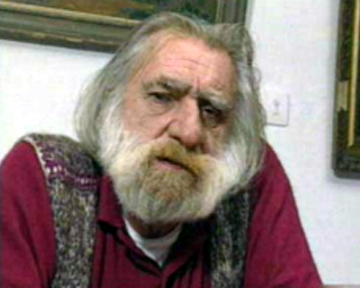
Continuing on my nostalgic November trip to the writers’ and artists’ circles in Turkey, I want to introduce you to Can Yücel, a poet to whom many biographers refer as “Can Baba” – Father Can (non-religious connotation). His poetry stands out with his use of colloquial Turkish, thus, making poetic compositions a product for the masses. The video below demonstrates a flawless reading performance of one of Can Baba’s most popular poems – “The Most Beautiful Part about Being with You”:
For my translation, I have chosen a different poem by Can Baba, namely his “Hayal Oyunu” – “A Play with Imagination”:
Hayal Oyunu
Ellerindi ellerimden tutan
Ellerimdi ellerinden tutan…
Bıraktığı anda ellerimiz ellerimizi
Gökyüzüne vuracaktı gölgeleri ellerimizin
Kimbilir kaç martılar halinde
Bir masada karşı karşıya
Seyrederken dudaklarını senin
Dile gelmiş ilk Türkçeydik
Henüz başlamış kül rengi bahar
Ne savaş, ne barıştık biz…
Bu dünyaya yeni gelmiş bir diyar
Manolyaya gece konmuş kumrular…
A Play with Imagination
It was your hands holding mine
Mine, holding yours…
The shadows of our hands were going to hit the sky
As soon as our hands left our hands
Who knows? In the form of how many sea gulls
//
We were the first spoken Turkish
While I was beholding your lips
At a table, across from one another
We were the newly setting smoke-colored spring
We were neither war nor peace…
//
A realm newly born in to this world
Doves, perched on the magnolia in the night…
~ ~ ~ ~ ~ ~ ~ ~ ~ ~ ~ ~ ~ ~ ~
I hope you have enjoyed your visit this Wednesday. I look forward to you stopping by next week again but also for your visit to my Sunday Reflections.
The scene shown above is claimed to be the most critical representation of the film “Eşkiya,” a groundbreaking contribution to contemporary Turkish cinema.The plot summaries in English of my finding don’t dwell on what this excerpt reveals with succinct emphasis; namely, the Leitmotif that holds this artistic production together: the story of Baran and Keje. It is a tale of love extending beyond the scopes of life and death, resonating the legendary loves in Turkish literature. Such as that between Ferhat and Şirin (12th century), Leyla and Mecnun (16th century), Kerem and Aslı (16th century), and others.
Keje buries herself in silence and inaction when the man who betrayed Baran to unjust imprisonment becomes her husband after he buys her from her father. Thirty-five years later, Baran is free again. His untiring search for his love embodies his only livelihood.
The storyline assumes numerous complications through unrelated events to create in Baran once again an innocent bystander of crimes he did not commit. Alongside, Baran confronts at last his worst enemy. In Keje’s presence. Her silence – her way of mourning for the loss of her love to life, will cease only then – she has Baran understand – if she were to witness a falling star. A symbol to her of a tortured soul attaining ultimate freedom – for both lovers…
While I can’t remember how far back in the past, I know exactly how I used to think about the phenomenon of love and its loss: a distinctive flair of melancholy lurked only over the people of Turkey – as with today’s few quick examples. But then, I discovered famous names of non-Turkish roots with the same approach to this utterly uplifting, at the same time soul shattering reality of life. And here I am, sharing some of my related deliberations with you in the form of a poem I have written recently:
when love is everything
among long-time friends once again
enduring the familiar left-side pain
decades surpassed their centuries
the hurt remains the same
an Immortal Beloved crafted life
birthed death ever so keen
a blazing desire in-between
oh geh mit, geh mit
oh accompany me, accompany me
Hebuterne embraced the call
Plath followed it with ease
Claudel suffered a living disease
King Edward VIII stunned the monarchy
etched to memory for lives to come:
the essence negates all that is told
nourishes from the authentic self;
sates and attains for evermore,
absolute ecstasy at the core.
For love is everything.
hülya yılmaz (October 3, 2013)
Have you ever grieved in deep sorrow for losing love but led yourself to conclude you had no right to mourn in the open because your loss was not one to death?
My heartfelt thanks are with you, dear bhuwanchand, for giving me the chance to reblog from your work with utmost enthusiasm and conviction. Long ago, I had posted an interview by Ted Koppel with Morrie Schwartz including his following words that had been haunting me since I first read them (as writtten by Mitch Album): “Death ends a life, not a relationship.” The key concept in your post, “love”, is, to me, the only power we can rely on in surpassing death. And there, certainly is no reason that can rule out such permanence.
In this dizzyingly rich novel of ideas, Mann uses a sanatorium in the Swiss Alps, a community devoted exclusively to sickness, as a microcosm for Europe, which in the years before 1914 was already exhibiting the first symptoms of its own terminal irrationality. The Magic Mountain is a monumental work of erudition and irony, tension and intellectual ferment, a book that pulses with life in the midst of death.
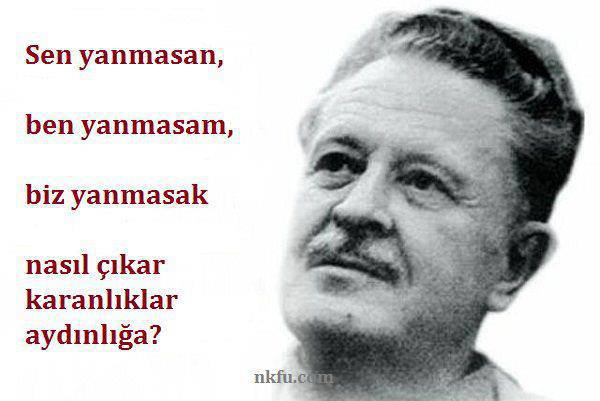
What Nazım Hikmet, the world-renowned exilic poet and thinker of Turkey stresses in his call for collective strength in harmony, is as follows: “If you don’t, I don’t, we don’t blaze, how can the darkness emanate light?”
Nazım’s invitation, to me, is one to awareness – a timeless gift to generations to come. If they were to be willing to listen to it, of course. No different than what John Lennon intended with his song, “Imagine”:
The following lyrics – in sync with the rest of the song, seem self-explanatory:
“[…]
Imagine there is no countries
It isn’t hard to do
Nothing to kill or die for
And no religion, too
Imagine all the people
living life in peace […]”
These remarkable visionary individuals are no longer among us. We, however, are. I, for one, have found my niche in the sharing of my awareness for this vital thought processing among the living: love for world peace – one I have been yearning for very long. It came to me thanks to the World Healing World Peace Poetry Anthology 2014 initiative by Inner Child Press.
Please know I am writing about this marvelous project not at all because I happen to have a submission of my own. I don’t. I won’t. If I had or were to plan to do so, I would have to step back. Here, I mean. For I have strict self-imposed rules regarding self-promotion. And, you all know how I treat my own work contribution – as you have seen my quite subdued announcement of my poems in an anthology by another publisher.
The conceptualization of world peace by the Inner Child Press is simply me finding home. Through collective poetry creation in order to attract attention across the world, spanning over the boundaries of countries. What a thought! In order to lend a long overdue balance against the power of violence – a trait of our world that has enjoyed dominance for way too long. But, that, is a learned trait. How can it stand – we may respond with a false sense of confidence – against the strength of love, an inborn asset of each human being? It can. It unfortunately can. And it does. It has. It will. As long as we keep letting it.
Once you live of what the same poet speaks in two separate poems through seemingly contradicting emotions, you know the feeling of being torn is an integral part of the suffering.






 hülyaswritings