Tag Archives: life

Toward a book project, “letter-poems to the beloved” – Week One

Good Sunday, dear reader!

You know my predicament: I am passionate about writing but I also love teaching. Beyond loving my decades-long professional commitment, I am having to allocate most of my time to its demands. The new semester is coming to a fast end but in an immensely time-consuming manner. I find it more and more difficult in this final month to reserve their deserved time aside for my Sunday reflections – to do any qualitative research on some issues of larger interest to us all, that is. I hope you won’t mind terribly, if I were to share with you one of my new poems for the end of each of the next few weeks. What I would very much appreciate from you is, any few minutes you may be able to set aside to comment on each poetic construct. If that were to be too much to ask, then, perhaps you would be willing to suggest a title for a larger writing project I have in mind in which to collect all these poems. In case you have an active account on facebook, some of them will appear familiar to you, as I have posted them on my page and/or timeline on that platform. What I have conceived so far for the project in question is in line with my core existential determinant – as I articulated it in my debut book:

“Love and melancholy. Two traits that defined me throughout my life thus far. Not very different from Oğuz Ozdeş’ Hülya – the young woman whose tragic love captivated my mother to the extent that she adopted her name for me. As I have said before, I have a commitment to love. When it comes to melancholy, I am considering a healing interaction with it – an initiative I have already prompted with my poems for Trance. I do intend to accomplish a continued healing, though. To begin to achieve such endeavor, I may have to write a different ending to Hülya but to hülya as well. And, I believe I will (from: Preface, Trance, a collection of poems in English, German and Turkish).”

I very much look forward to your comment and your next visit. May the rest of your day and new week be filled with joyous events and interactions.

~ ~ ~ ~ ~ ~ ~ ~ ~

do you think back

to remember it all

how i lain on the mossy ground

blanketed myself with your scent

the quiet creek of our first encounter

encircling the rays of an afternoon sun

how it slowed its path to honor our euphoric reunion

to watch us flow into one another – learned and approved…

wind and air however envied pulled their forces together

thus came an end in a lightning – fiercely brash


my graceful i kept at bay its dire hope to let you float

what ifs of our dread are adamant in haunting me yet

would i have now been immersed by you instead

had i not defied the boulder at the barricade…


i was meant to love you

and i still do


© hülya n yılmaz – March 14, 2014


POSTED.image for meant to love you

6 Comments

Filed under Poetry

existential crisis or incomparable bliss?

POSTED.image for ölümü düşünüyorum


POSTED.FBTimelinePhoto


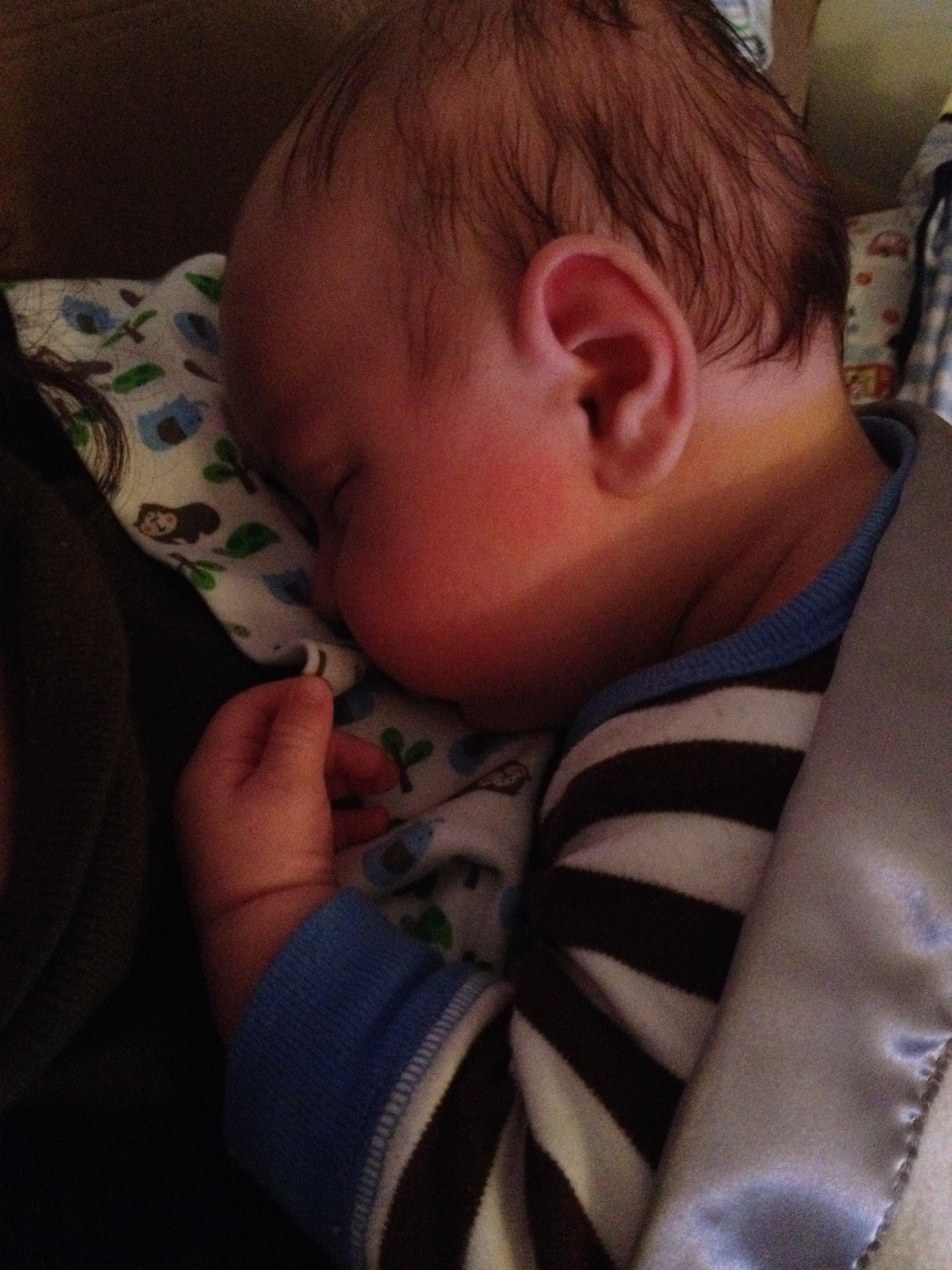
You would all believe me, if I told you he is far more beautiful than this picture does him justice, wouldn’t you? Yes! This image is of my grandson’s. His unintended pose here is utmost precious to me because the shoulder on which he has fallen asleep like an angel of my childhood fantasies happens to be mine. I remember having frozen my daughter right on the spot with my smile of who knows how many thousands of volt. My shoulder has been in this position many times before – in fact, my photo here is an older one when my tiny love had just made it to his two months (he is three-and-a half months old in his photo here). With my lucky charm’s shapely head, chubby cheeks, button nose, mother’s mouth and heavenly breath for me to inhale and never let go from inside me. And, those tiny hands with their father’s fingers – just recently freed from their sharp-nail-repellent baby mittens (his grooming kit is very difficult for his mom to near him with…)! Closing and opening at his dreams’ will to let me know I am there with him. In flesh and blood.

Then, I get to go home. Alone. Days go by fast with demanding work.  The nights should follow suit. For, a teacher’s duties multiply outside the classroom to occupy all evenings, weekends and holidays. I end up doing some more work. But, I get distracted (affordably so, of course) and have the urge to write. About many issues of and angles on our existences. The night when my poem below came to me was exceptionally intense in some personal longing and recollection of a recent loss (to life). I had already started mourning over my self without having exited my lifespan yet…On account of “things” not having been possible for me to materialize, nor to hope for, feeling out of time, and other similar harsh realizations. Being made foremost of emotions, my typing took me to an experience of angst. Not for myself, though, but rather only for the afterward. The ultimate innocence, a fully submissive display of trust, the purest and most unconditional love and eyeful of whole body excitement my grand baby was giving me as a priceless gift began to overwhelm me. It was, as if I had just realized what had happened: I, indeed, was the grandmother of a miracle baby boy. Moreover, with him becoming acutely aware of and visibly happy about the wordless interaction between us. Melancholy hit me. The outcome was the following short verse in my native tongue…(an English translation of it is right beneath the original):


ölümü düşünüyorum

eskimiş kalıbıma konup duran inanılmaz bir güzellik nefesinde

yol yorgunu soldakine en karşılıksız masum sevgi gözlerinde

hani cennetten derler ya, işte öylesine kökten gülüşlerinde

korkum sadece benden sonra göreceklerine


i am thinking of death

an indescribable beauty in his breath touching on and off my worn out frame

the most unconditional purest love in his eyes for the trek-weary one on my left

you know how they say: of heaven? such original depth in his smiles

my sole fear

what will he be dealt with

after me

~ ~ ~ ~ ~ ~ ~ ~ ~

I wish you all thoughts on and plans for life alone and look forward to your visit next Sunday!

14 Comments

Filed under Reflections

Helva, Halva, Halwa, …

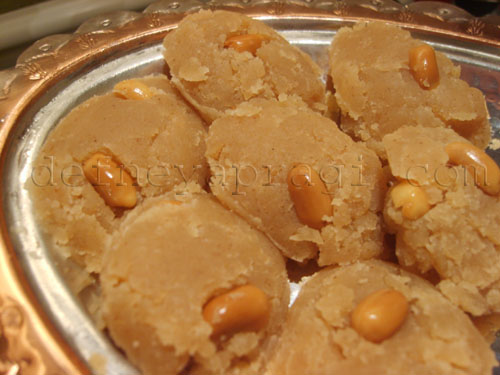
Even after several decades passed since I last smelled it coming from my mom’s kitchen, the aroma of its slightly burned delight feels on the roof of my mouth.  “Just because,” she answered, when I first noticed she was making it outside the expected occasion: death.  The fortieth day of a death close to the family’s heart would warranty it, after which it would be repeated on the anniversary of that passing.  “In remembrance of the loss of our beloved among us, to have the strong whiff reach their souls,” my mother would utter on those occurrences – in a very soft voice, almost inaudible.  But that day, it was “just because.”

I absolutely loved then and love now the taste of un helvası (Turkish spelling), the Flour Halva/Helwa but also was engrossed in its unmistakable aromatic tour throughout our three-bedroom flat.  As I am writing now, my mother’s quick hand gestures stay glued to my mind’s eyes; how she would shape this very slowly fried butter, flour, sugar and milk mixture – something that doesn’t look like much at first – into edible rows of a finger dessert (I made up this term based on the English “finger food”), each topped either with a home-roasted raw almond or a large pine nut.  Her helva-making rituals became a more frequent act after that time.  Only after she died was I able to conclude how making that sweet dish had become her own way to feel connected to our beloved dead.  Through the first connector we experience right after our birth: partaking in the festivities of the palate.

~ ~ ~ ~ ~ ~ ~ ~ ~

May your Sunday and new week be filled with delectable life experiences, and may you come back to share some of them right here, over an imagined cup of Turkish coffee and a helva of your choice to celebrate a joyous event.

~ ~ ~ ~ ~ ~ ~ ~ ~

Related Links:

Ceremonial Significance

Definition in Encyclopedia Britannica

Definition in Wikipedia

Description of the Different Helva Types

History and more

Leave a comment

Filed under Reflections

In good company

As I do when I teach the undergraduate literature course – to help my students see beyond the inaccessibility of classical writers, I called for my imagination also for today.  I let it transfer me to the times of three such well-known literary names: Robert FrostFlannery O’Connor, Ray Bradbury.  The reason beyond the urge to gather a virtual literary circle to connect in one form or another (no ghost-calling séances here) to writers no longer living was not the course in question this time.  I had been working on a poem of loss part of last week.  Prior to that work, I had completed a short story centering it around the crime of honor killing.  Severe sadness had set in after both processes.  In moments like these, I tend to prefer not to bother my daughter or a friend.  I seek comfort in penned emotions of writers from a seemingly spectacular past.  The following words gave me the calm I had been seeking to achieve this time.  Not because they define joyous feelings but rather thanks to their affirmation of the one specific human state that motivates us to write – sadness in face of reality.  There are going to be other phases when I end up feeling the pull of sorrowful moments again.  And again.  Also then, I know, other penned words will come to help me ease them.  To reassure the reality of life is here to stay with its highs and its ills.  Here are the famed authors to state what we, too, experience day in, day out.


07bradbury2-span-articleLarge

[Ray Bradbury (1921-2012)]

“You must stay drunk on writing

so reality cannot destroy you.” 


[Flannery O’Connor (1925-1964)]

Flannery-Oconnor-9426760-1-402

“Writing a novel is a terrible experience during which the hair often falls out and the teeth decay. I’m always irritated by people who imply that writing fiction is an escape from reality. It is a plunge into reality and it’s very shocking to the system.


???????????

“A poem begins with a lump in the throat; a homesickness or a lovesickness. It is a reaching-out toward expression; an effort to find fulfillment. A complete poem is one where an emotion has found its thought and the thought has found words.”


[Robert Frost (1874-1963)]


Robert Frost [Quote]

Flannery O’Connor [Quote]

Ray Bradbury [Quote]

Leave a comment

Filed under Reflections

Hani

Nazım copy

Hani derler ya,

Ben sensiz yaşayamam, diye.

Ben onlardan değilim.

Ben sensiz de yaşarım;

Ama,

Seninle bir başka yaşarım…

[Poetry and Image Source: Nazım Hikmet]


You know what they say:

“I can’t live without you.”

I am not one of them.

I’ll live also without you;

but

with you,

my life would surely be something else…

[Translation Source: Self]


May it be through Turkish, English or any other world language – how do you define “living”? How about “life”?

2 Comments

Filed under Reflections

Dying into love

Last Sunday, my reflections were all about thanking you, dear reader.  As on any day of your visit, also today I have my thanks for you but also some thoughts on the relationship between love and death.  Love – the essence of life.  In the loss of which immeasurable pain rules, seizing the soul in its gradual death.  At times, taking along also the remainder of the person, as my contemplations on three famous examples will show.  All women.  The biographical details on each are widely known.  Therefore, I won’t bore you with a repetition.

Jeanne Hebuturne, the last love of Amadeo ModiglianiSylvia Plath, the love and wife of fellow poet Ted Hughes and Camille Claudel, the lover and muse of  Auguste Rodin.

 “Modigliani”, the film begins with Jeanne Hebuterne before her jump to her death, asking, if we ever lived love, “real love” to the extent that we would “condemn” ourselves to “eternity in hell”.  As she has:

In the film, “Sylvia” the poetess suffers immense pain grieving the loss of her husband to an affair:

Her repeated utterances, “I’m going to die, I’m going to die” foretell her dying into love before her suicide takes place:

In the same titled film, Camille Claudel’s destruction following the end of her affair with Rodin, for whom she is claimed by respected biographers to have been the muse, is very difficult to watch, for she is in infinite despair:

She doesn’t commit suicide.  But also her life ends as she, too, dies into love.

Death.  A topic requiring an open-ended discussion of phenomenal context.  An attempt I won’t even pretend to be able to make.  My only intent is to offer a definition of it through research compiled in the Stanford Encyclopedia of Philosophy: “[T]he irreversible cessation of organismic functioning and human death as the irreversible loss of personhood.”

An all-consuming love is what the three women of my focus had lived.  How their “organismic functioning” and “personhood” had terminated in ‘irreversible’ manner, does not matter.  What the loss of their love consumed off of them, does.  I know for I have been there.  Not once, not twice but three times already.  After the loss of my first love.  Following my mother’s death – by its encyclopedic definition.  When I lost my late love.

As for my love for my daughter, my only child, my fear over my own death compares nothing to the anguish I feel and have felt since her birth for any hurt she may have to suffer.  But, this issue deserves an entire reflection column all by itself.  And I better get you to my conclusion for today.  Namely, the following statements of fame attesting to the fact that there, indeed, is death for some of us before death – into love, of the heart/inside, of hope, of inspiration, of awareness:

“It is love, not reason, that is stronger than death.” – Thomas Mann

“The heart dies a slow death, shedding each hope like leaves until one day there are none. No hopes. Nothing remains.” – Arthur Golden

“The tragedy of life is in what dies inside a man while he lives – the death of genuine feeling, the death of inspired response, the awareness that makes it possible to feel the pain or the glory of other men in yourself.” – Norman Cousins

“What is called a reason for living is also an excellent reason for dying.” – Albert Camus

“Many people die at twenty five and aren’t buried until they are seventy five.” – Benjamin Franklin

Leave a comment

Filed under Reflections

NaPoWriMo Challenge: Day 27 – IN CELEBRATION OF A VERY SPECIAL BIRTHDAY

Für meine liebe Lilia Felice Siede, die ich dank meiner liebsten Yasemin Ergün als Neugeborenes in meinen Armen als die “hülya Teyze” halten durfte: Meine herzlichsten Wünsche zum Geburtstag! For my dear Lilia Felice Siede, whom I was allowed to hold in my arms as a newborn as her “Auntie hülya” thanks to my dearest Yasemin Ergün: My most heartfelt wishes for your birthday!

I have written this poem also to honor the memory of my long-deceased cousin, Yasemin Ergün from her heart who was robbed by a fatal cancer of any opportunity beyond a mere one year to celebrate her daughter’s much sought birth.

To all cancer survivors: May you live long, healthy lives with your loved ones!


Lilia, *mein Schatz

you won’t know me

I left too soon


you were born of love and longing so strong

made me feel immortal by your side

merely a year, though, is all we had aside


you are a young woman now,

beautiful, bright and loved very much

no longer the tiny darling in my arms

precious but ever so fragile,

sending me beams for immense joy

shaming even the cancer of its call


it is your birthday today

I am not there for you again

but don’t be sad as you are not on your own


also the one with whom you locked eyes long ago


in my in-laws’ house, on the ground story

when we were cradling you, a newly born beauty

the one who probably mirrored me to you

for the color of her skin, hair and eye

whose both arms better secured you many a meal

before you glided into a sleep so deep and real


embraces you always with my and her love combined

whom I introduced to you in her mother’s tongue

you know, mein Schatz, you have met her online anew

the one who signs her e-mails hülya *Teyze for me and you


~ ~ ~ ~ ~ ~ ~ ~ ~ ~ ~

* (German): my treasure; my darling; my sweetheart

* (Turkish): aunt; auntie (non-biological)

3 Comments

Filed under Poetry, Reflections

NaPoWriMo Challenge: Day 7

scan reading


world


“Afghan children ‘killed by Nato’ […]

10 children and two women […]

air strike […]”

“UK urges calm over N Korea crisis […]

despite the ‘paranoid rhetoric’ emanating from Pyongyang.”

“Cairo clashes follow Coptic funerals […]

of four Coptic Christians

killed in sectarian violence.”


“U.S.

Delays Missile Test Over Tension With North Korea”

“Kerry warns Iran time is limited […]

on its nuclear programme [… .]”

“New Recruits Combat Sexual Assault In The Air Force”

“The First Gun In America”


scan reading

again


world

U.S.


violence

war

more violence

more war

contemplations on violence

on war


“Kansas Set To Enact Law Saying Life Starts At Fertilization”


What if

we were to lend a life first,

one deserved by those already born?

Leave a comment

Filed under Poetry

For Education: Acts of Cowardice and an Act of Courage

Against the backlash of sickening shouts of joy by numerous Taleban followers during the execution-style shooting of a man amid a forced crowd – point-blank in the head – onto the ground where a headless corps lies and a girl screams while being flocked face down in dirt, all for a so-called lesson by a group of armed men, Malala Yousafzai’s voice rises in confidence: “They cannot stop me.  I will get my education. If it is in home, school or any place.”  All, in the video below.  The man’s head’s image revokes that of the imagined one of Malala in her school bus several months ago.

A statement from Seneca sums up the now widespread news on the cowardice behind the Talebani shooting of Malala in the head and chest: “All cruelty springs from weakness (Seneca’s Morals).”

No, oh no! It is not at all my intent to re-visit that low moment in Malala’s life beyond these words of reminder of her trauma.  For it is, rather, sharing of the most recent, joyous news that is most deserving of her strength: Being discharged from the hospital after her life-threatening wounds, having risen above the impact of the cowardly act by a shooter from the realms of ultra-conservative Islam as well as that of all its representatives.  Malala leaves hospital and addresses the world as the symbol of courage.

Various media speculations guide the reader and/or viewer to the potentiality of a plot behind the shooting of Malala, to which – among many others – “The assassination of Malala’s character,” an arab news article, responds.  Not being a political scientist of profession, of greater importance, though, not ever having cared for the value of any political structure at the level, let alone, above that of the human being, I, with my reflections today, am in obvious act of detest when the cowardice of the ultra-conservative Muslims is concerned – may they hide behind the name “Taleban” or under any other title.

The fact remains the one and the same: Malala wanted to have education be open to her and knew too well that the Koran did not ban her from pursuing it.  Talebani shooters had to face growing fear on account of her “act” of a learned individual: A passion to live under her terms; that is, to lead a life within her rights as a human being.  But also for being educated enough to know that the Holy Book of Islam she believed in was in support of her pursuit when it came to equal rights for education for Muslim boys as well as girls anywhere in the world.

Plutarch is claimed to have said the following regards education: “The mind is not a vessel to be filled, but a fire to be kindled.”  How relevant of a statement of wisdom when our days are taken into consideration in view of the mind (intended singularity) of the Taleban followers as opposed to that of Malala…

You, dear reader, may – in the words of Gandhi always possess passion and courage for education and thus, “[l]ive as if you were to die tomorrow. Learn as if you were to live forever.”

1 Comment

Filed under Reflections

“How old is s/he?”

His mother died when she was 48.  His brother died, having been able to pass a mere 32 birthdays.  His sister died also at the age of 48.  He had to give his daughter to death when she was only 31.  He had cancer before she was diagnosed with hers.  Soon after she died, his body formed another type.  A third struck him last week.  Not metastasis of his first, or the second.  A new one.

He is 82.

He practiced medicine right after his graduation from the medical university in Istanbul, Turkey.  Having served for decades in Germany as the head physician in the hospital from where he retired years ago.  He knows what must be done when, whenever medical interferences are concerned.  He has led countless surgical procedures during his tenure.  He has tended to post-surgery needs of his numerous patients of all ages and walks of life during his time.

The medical staff of the hospital where he has had two surgeries in short intervals, responded to his two calls for alarm after half an hour had passed.  One was for dangerously low, the other for dangerously high blood pressure – both along with breathing difficulties. Half an hour of a wait!  On the night of his surgery!  Why not take longer to let the patient develop fatal post-surgery complications?  He lived 82 years, after all, isn’t that enough?

Describing the ordeal she and her 55-year-old husband had because of his cancer and ensuing death, Cheryl Eckl makes a remarkable statement in her essay, Elder Grief: The Hidden Burden of Advanced Age. Why growing really old may be worse than dying young (Published on May 24, 2012 by Cheryl Eckl in A Beautiful Grief: “[…] what he was not suffering was the additional burden of advanced age.”  Referring then to her mother’s declining health at a very advanced age, Eckl considers “that perhaps even worse than dying young is living to be very old, with little quality of life due to several serious ailments, but not being sick enough to leave this world.”  Her mother, Eckl writes, knows several people “who would be very happy not to wake up tomorrow.”

On this blood-freezing sentiment, Eckl contemplates as in the following: “That is the cruelty being suffered in obscurity by millions of the elderly who are shut away in nursing homes and senior living centers across the United States. Bored, lonely, in pain, or so demented or sedated that they don’t know who they are, these are the forgotten mothers, fathers, grandparents, aunties, and uncles who deserve better attention than they are receiving.”

For the onset of her cancer and the metastasis of it, my mother was treated through surgical procedures in Turkey and in Germany.   Three decades ago.  My mother didn’t want to be advanced in age to the extent that she would no longer be able to live a life of quality.  She got her wish.

My uncle’s “case” is happening in Germany.  Today.

The United States, in other words, is not the only cultural entity where this “cruelty” goes on.

For people who are among those living beyond their expected age of death – whatever that may be, Eckl invites us to imagine how for them “the borders of daily experience narrow as distress grows and the ability to perform all but the simplest of tasks disappears.”   What does Eckl suggest as a balm for a life having to consist of “a succession of doctor appointments and increasingly invasive and dehumanizing treatments”?  Love and our presence in their lives.

He is 82.  He has always been present in my life.  And still is.  In Eckl’s words, he has never deprived me of his “heartfelt presence” (Eckl) Or, of his love.  Unconditional love.  After my mom’s death, he told me he finds in me his mother – “Anamsın” and his sister (my mom) –“Bacımsın.”  After his daughter’s death, he saw her in me – “Kızımsın.”

In him, I always found a fully involved father.  I still do.  I went through many ordeals.  He was there for me during each one of them.  I love him so.

Where is, though, my heartfelt presence when he needs it the most?

Dayı, beni affet.

2 Comments

Filed under Reflections