Once again, I will meet a daily NaPoWriMo challenge, namelyDay 18 by Cathy Evans – according to whom one is expected “to write a poem that begins and ends with the same word.” Before I venture into my poem, though, I want to take us all to Encyclopedia Britannica for a background information on in medias res,the literary technique of mention within the same prompt:
“( Latin: ‘in the midst of things’) in narrative technique, the recommended practice of beginning an epic or other fictional form by plunging into a crucial situation that is part of a related chain of events; the situation is an extension of previous events and will be developed in later action. The narrative then goes directly forward, and exposition of earlier events is supplied by flashbacks. The principle is based on the practice of Homer in the Iliad and the Odyssey. The Iliad, for example, begins dramatically with the quarrel between Achilles and Agamemnon during the Trojan War. The Latin poet and critic Horace has pointed out the immediate interest created by this opening in contrast to beginning the story ab ovo (‘from the egg)—i.e., from the birth of Achilles.”
On this fifteenth day of the NaPoWriMo challenge, I am embracing (as I have done some other times) the “([…] totally optional) prompt! [… Namely,] to write a pantun Not a pantoum — though they are related. The pantun is a traditional Malay form, a style of which was later adapted into French and then English as the pantoum. A pantun consists of rhymed quatrains (abab), with 8-12 syllables per line. The first two lines of each quatrain aren’t meant to have a formal, logical link to the second two lines, although the two halves of each quatrain are supposed to have an imaginative or imagistic connection. […] The associative leap from the first couplet to the second allows for a great deal of surprise and also helps give the poems are very mysterious and lyrical quality.”
Tanam selasih di tengah padang,
Sudah bertangkai diurung semut,
Kita kasih orang tak sayang,
Halai-balai tempurung hanyut.
[The original example above has also been provided by NaPoWriMo]
I have liked the challenge this time so much that I tried to compose Pantun poems in the three languages I am familiar with. All three poems below are my original work: Not translations between the different languages but each holding its own content within the prescribed lyrical form.
*Biz bu kızın başını yedik!” (Turkish) A loving tribute to a living child whose life quality may have been compromised on account of parental mistakes.
It is not even the month before the one of Fathers’ Day. Yet, my reflections today are about fatherhood. That state of being for a man enters my mind in severity at least every time my daughter sees her father. Today is the day after one of those occasions. Two statements on the subject had actually attracted my attention long time ago. One, from an anonymous source: “Any man can be a father. It takes someone special to be a dad.” The other, a Shakespearean quote: “It is a wise father that knows his own child.”
Of course, the same is true for mothers but my thoughts today dwell only on the “father” and in lyrical form, at that.
NaPoWriMo – About announces: “And now our (totally optional) prompt. […] Today I challenge you write a poem inspired by noir — it could be in the voice of a detective, or unravel a mystery, or just describe the long shadows of the skyscrapers in the ever-swirling smog. […]”
Diogenes (the philosopher and the true Sinopian): “He has the most who is most content with the least.”
I (a Sinopian by soul): Oh, you Honorable Diogenes of Sinope – however poorly esteemed you may have been during your lifetime, I am a true admirer. Forgive me for my ignorance: Had you intended your pronouncement to be a gender-sensitive one?
Diogenes: ?
I: In other words, gender-neutral?
Diogenes: ?
I: (What on earth am I talking about? Back to his century! Fast!)
You can’t see that far but I am a woman. One of those creatures whom Alexander the Great had offered you, among other necessities of your desire. (Oh no, it is so very demeaning for me to talk like this…) You, however, only wanted him to step out of your sunlight.
Diogenes: I know women. Never needed one by my side but I know. Go on!
I: I am honored to come from a long line of Sinopians but the only Sinopian I have known to have almost coveted to lead a life as you have, was a man as well.
Diogenes: As accepting and as understanding the inhabitants of Sinope may be today, a life on the streets, solely living on bare necessities and staying in constant public eye is not for you.
I: So I see.
Diogenes: Something lies heavy in your heart, I sense. What is it?
I: My mind gets filled with advice on how to live. I respect the past of thinkers like you with highest regard and try to heed the teachings.
Diogenes: As long as you leave out any words of abstract nonsense from Plato and Aristotle!
I: No, oh no. I was going to mention Democritus and what he is known to have said.
“Happiness resides not in possessions and not in gold; the feeling of happiness dwells in the soul.”
Diogenes: Good, that’s good. Whom else have you been listening to?
I: He exists in my century and a very well known statement of my time comes from him.
“The very purpose of our life is Happiness.”
Diogenes: Hmm.
I: Is there something the matter, you Honorable Diogenes of Sinope?
Diogenes: I must and shall think about this.
I: Dalai Lama has spoken out countless words on “happiness” and those always bring me back to yours. As His Holiness is living proof.
Diogenes: I see. But still, what is “happiness” to us is utmost important because we all can have a different definition of it. Democritus’ words, for instance, use “possessions” and “gold”. What possessions? What gold? For me, it was owning nothing, being in nature, living free and unplanned. Like dogs. With dogs, whenever necessary.
I: Just like the “tarzan” of Sinop? Again, of my century. In fact, I had the rare opportunity to witness him in person several times from nearby.
Diogenes: You say he is all the way from your century and from my birthplace? Now, that I find interesting. Tell me about him.
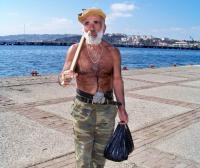
I: First, here is a picture of Sinoplu “tarzan” (I hope he would have forgiven me, had he lived, for using the attribute he is said to have disliked so):.
Diogenes: ?
I: Oh, picture. We now have paintings of you, which are similar to pictures. To better imagine how you may have looked.
Diogenes: He looks good. Like me.
I: Yes, I would agree, you Honorable Diogenes of Sinope. And here is an article on his life and death, Sinop’un Simgesi Tarzan Kemal. He is said to have disliked the nickname “tarzan” the Sinopians had attributed to him. He had no house, only possessions of survival value, fed the dogs of the town and beyond, respected nature.
Diogenes: (article? I better let this one slip. I still have to find food for tonight, and feed the dogs. This woman is full of words I haven’t ever heard before. If I ask her this one too, this conversation will never end…) If he had, indeed, lived helping the dogs, respecting nature, refusing material possessions, then, you are right in seeing in him a piece of me. But what is that with him supposedly having fallen in love with his family’s maid, and out of that unfulfilled love, having acquired his now widely known lifestyle?
I: We, Turkish people, love melancholy more than anything else, is what I think.
Diogenes: Turkish?
I: Do forgive me, you Honorable Diogenes of Sinope!
Diogenes: Turkish?
I: A mere slip of the tongue…
Diogenes: All I said was,
I: (I can’t believe I am interrupting the Great Cynic Diogenes…) Yes, yes. “He has the most who is most content with the least.”
Diogenes: How, then, did we end up here with this conversation?
I: I called upon you. Because of my prolonged concerns. My time in my society is about having more and more material possessions, living in large homes, and sometimes, I can’t help but find myself at a loss with these expectations.
Diogenes: What did I say? He has the most who is most content with the least.
I: But then, there are some people who are content with basic necessities. And when they do resort to a life “with the least”, they become a viral hit.
Diogenes: ???
I: (Oh my, I did it again…) I beg for your forgiveness, you Honorable Diogenes of Sinope. They are then somewhat known, is what I meant to say.
Diogenes: Can you tell me something about them?
I: Certainly. Here are the links of …
Diogenes: (links?)
I: some who have been downsizing
Diogenes: (downsizing?)
I: Honorable Diogenes, I am afraid we are losing the connection.
Diogenes: (connection?)
I: May we, please, continue this conversation on Skype?
Diogenes: ???
~ ~ ~
I: “He has the most who is most content with the least”? I wonder what he meant by that…
(TO BE CONTINUED…WITHOUT THE GREAT DIOGENES, IMAGINED OR NOT)

 hülyaswritings