Tag Archives: Poetry

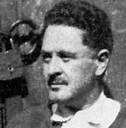
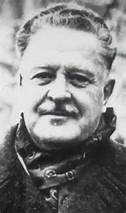
Nazım Hikmet (1902-1963): A lover – of women and his country of birth

th-2 thNazım-Hikmet-Hoş-Geldin-Kadınım-Şiiri-e1341589160999-150x150th-1


At times, we believe what we want to believe, don’t we?  Similarly, we refuse to believe what others may claim?  Such as an attribute given to a well-known poet?  Just like I do, with Nazım (I don’t even want to refer to him with his full name – it feels so very alien and impersonal…), the world-renowned Turkish exile poet.  I never believed he was a traitor, as claimed by some officials of Turkey in the past (there was a retraction of such claims after Nazım’s death), nor a womanizer (but a lover of love, one woman at a time). When this most influential writer died (on exile, craving to be in his country of birth), I was a mere eight year-old.  My passionate engagement with his poetry and other writings have everything to do with the development and intensification of my own interest.  Not because of schooling on his persona and work, or parental introduction (on the contrary: I believe my father was also under the negative influence of one of Turkey’s population segment; my mother always remained neutral – she wouldn’t comment at all, I suspected she, too, liked him outside the norm…).  The more I actively read Nazım’s written word, the more drawn I became to everything he stood for.  Let’s call him my very first crush, okay?  Incredibly handsome, a stellar composer of poetry, the center of attention of the entire country – for this or that reason, immensely influential nationally as well as abroad: a timeless love, to admit.  For today, I have for us two examples from his poetry – not at all the most frequently cited ones, by the way.  Both works address his love for which he was known to have possessed an extraordinary passion: one, to a woman (“Ben senden önce ölmek isterim”, “I want to die before you”); the other (“Sen”, “You”), to Turkey, his country of birth – one among his numerous poems of homesickness.  It is not any time of anniversary for Nazım.  I am reminiscing him simply because during most of my awake times, he is in my heart and mind.  For, at this stage in my life, I finally am aware more of his value for and contributions to world literature – a subject matter of my special interest as far as my professional undertaking.  I hope you will enjoy this short journey in to a glorious past of the Turkish civilization of contemporary times – an aspect of the country that today is fading away fast and under the harshest possible forces.


Ben
senden önce ölmek isterim.
Gidenin arkasından gelen
gideni bulacak mı zannediyorsun?
Ben zannetmiyorum bunu.
İyisi mi, beni yaktırırsın,
odanda ocağın üstüne korsun
içinde bir kavanozun.
Kavanoz camdan olsun,
şeffaf, beyaz camdan olsun
ki içinde beni görebilesin…
Fedakârlığımı anlıyorsun :
vazgeçtim toprak olmaktan,
vazgeçtim çiçek olmaktan
senin yanında kalabilmek için.
Ve toz oluyorum
yaşıyorum yanında senin.
Sonra, sen de ölünce
kavanozuma gelirsin.
Ve orda beraber yaşarız
külümün içinde külün,
ta ki bir savruk gelin
yahut vefasız bir torun
bizi ordan atana kadar…
Ama biz
o zamana kadar
o kadar
karışacağız
ki birbirimize,
atıldığımız çöplükte bile zerrelerimiz
yan yana düşecek.
Toprağa beraber dalacağız.
Ve bir gün yabani bir çiçek
bu toprak parçasından nemlenip filizlenirse
sapında muhakkak
iki çiçek açacak :
biri sen
biri de ben.
Ben
daha ölümü düşünmüyorum.
Ben daha bir çocuk doğuracağım.
Hayat taşıyor içimden.
Kaynıyor kanım.
Yaşayacağım, ama çok, pek çok,
ama sen de beraber.
Ama ölüm de korkutmuyor beni.
Yalnız pek sevimsiz buluyorum
bizim cenaze şeklini.
Ben ölünceye kadar da
bu düzelir herhalde.
Hapisten çıkmak ihtimalin var mı bu günlerde?
İçimden bir şey :
belki diyor.

                                                                18 Şubat 1945
Piraye Nâzım Hikmet


My translations of both poems – in the hope that I do some justice to their magnificence:

I want to die before you (“Ben senden önce ölmek isterim”)

February 18, 1945 – To Piraye [It is also argued that this rare find was a poem Piraye wrote to Nazım, instead of Nazım to Piraye.]


I want to die before you

Do you think the one who comes after will find the one who is gone?

I don’t think so.

You’d better have me cremated,

you can place me atop the wood burner in your room inside a jar.

Let the jar be of glass,

transparent, white glass

so that you can see me inside…

You understand my sacrifice:

I give up becoming a piece of the soil,

I give up becoming a flower

just to be next to you.

And I turn to dust

living next to you.

Then, when you also die

you can join me in my jar.

And there, we will live together

your ashes, within my ashes,

until a careless daughter-in-law

or a disloyal grandchild

throws us out of there…

But we will intertwine in each other

until then, so that.

once thrown in to the garbage,

even there, our particles will fall next to one another.

We will dive in to the soil together.

And one day, if a wild flower

should find water and bloom out of this piece of soil

on its stem, two flowers will open:

one you

one I.

I don’t think of death yet.

I will give birth to one more child.

Life explodes out of me.

My blood boils.

I will live, and much, very much,

but you, also.

Considering,

death doesn’t scare me, either.

I just find our burial style too distasteful.

I assume that will correct itself until I die.

Is there a chance you will be let free [of imprisonment] these days?

Something inside me says: maybe.


nazmhikmet


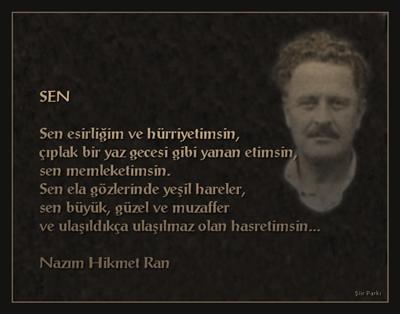
Sen (You)

You are my slavery and freedom,

my burning flesh – as it were a naked summer night,

you are my home.

You, green ripples in her hazel eyes,

you, big, beautiful and victorious

and my longing, the more unattainable whenever neared…

~ ~ ~ ~ ~ ~ ~ ~ ~ ~ ~ ~ ~ ~

As always, I wish you all a wonderful Sunday and an equally wonderful week! I very much look forward to your visit next time.
Leave a comment

Filed under Reflections

…self-centered…

My dear visitors,

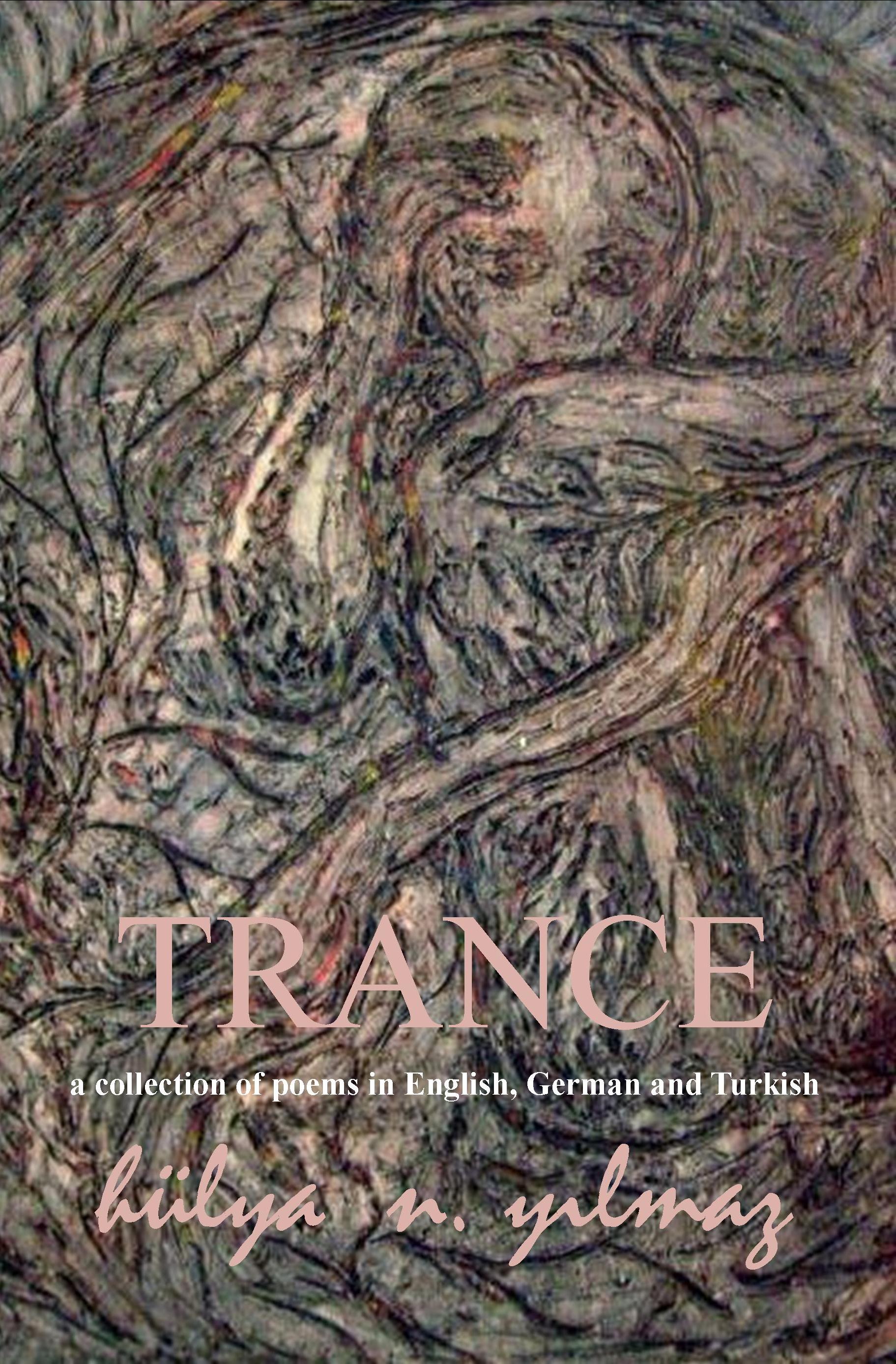
I hope you won’t find me overly self-centered for sharing with you this time a high moment in my life when my creative writing is concerned: My Trance, a collection of poems in English, German and Turkish has found its voice! Both highly accomplished poets, William S. Peters Sr. and Janet P. Caldwell of Inner Child Press – the remarkable publishing enterprise I have written to you about a while ago – have given a life to my tri-lingual poetry.  You know you had them, at least a few, right?  Those mind-boggling moments of euphoria?  I have been in such state since early afternoon yesterday, when I found out my book of poems is really in print now.  What I have fantasized often since middle school has become a reality.  Simply because the two professionals of Inner Child Press, ltd. listened to my poetic stories of three different cultural conceptualizations and corresponding life experiences with much care and love, giving me the life-time opportunity of a three-fold literary voice.  The picture below shows you the cover, “Le’nfant” – an original artwork by the artist and poet Siddartha Beth Pierce . An excerpt from my prose, then,  follows on the right – a small segment of the framework within which I provide my readers the transnational context behind my poems:

TRANCE Cover Front Final


My poems tell you about a life passed by me, at the same time – with their mere appearance in this book, they announce to you and me a life I decided to live.  Whether their construct is in English, German or Turkish, I strongly hope you will recognize your own stories in them.  However, I wish you will mostly relate to the poems of rejoice and not need to seek solace in those where I mirror countless moments of deep sadness.


I hope you will find it in your heart to join me in a celebration of not only my high moment but those I wish for all of us to come our ways in one form or another.  Then, as always, I wish you the best in everything and look forward to your visit next Sunday.

~ ~ ~ ~ ~ ~ ~ ~ ~ ~ ~ ~ ~

After posting for this morning, I have discovered the following remarkable words by a fellow-poet – whom I fondly call a son (whom I never met).  Since this is my day of self-promotion (smiles…), I will go ahead and share with you his insight in to my Trance:

TRANCE

Hülya N. Yılmaz, in this soulful poetry collection of hers displays high level of intellectualism that will keep a reader digging incessantly in order to fully explore the richness of her eloquent expression.

As a reader, I had to connect my soul to her writings in order to extract the undiluted message Hulya has for the world.

Written in three dominant languages; Tukish, German and English…Hulya achieves what many will term impossible as she unites and creates a unique blend with these three languages without a depreciation in the appreciation of her profound expressions.

I cannot help but further continue to address Hulya N. Yilmaz as a literary mother whom I need to associate myself with so as to graduate to the level of excellence where mediocrity is shamed.

My heart is endeared to this awesome collection (Trance), and my love for the writer is strengthened beyond breakage…I have no choice but to address her as “mein Schatz” ( You care to know the meaning of these strange words? Go get the book)
Book available via link: http://www.innerchildpress.com/hülya-n-yilmaz.php

~Kolade Olanrewaju Freedom

Related Links:

Siddartha Beth Pierce

Hülya N. Yılmaz

Facebook Site for Trance

Kolade Olanrewaju Freedom on Facebook

The Light Bearer – Poetry Book by Kolade Olanrewaju Freedom

The Light Bearer by Kolade Olanrewaju Freedom – Book Review by Celestial Wisdom

2 Comments

Filed under Reflections

Once upon a winter…

My friends at The River, 6 copy

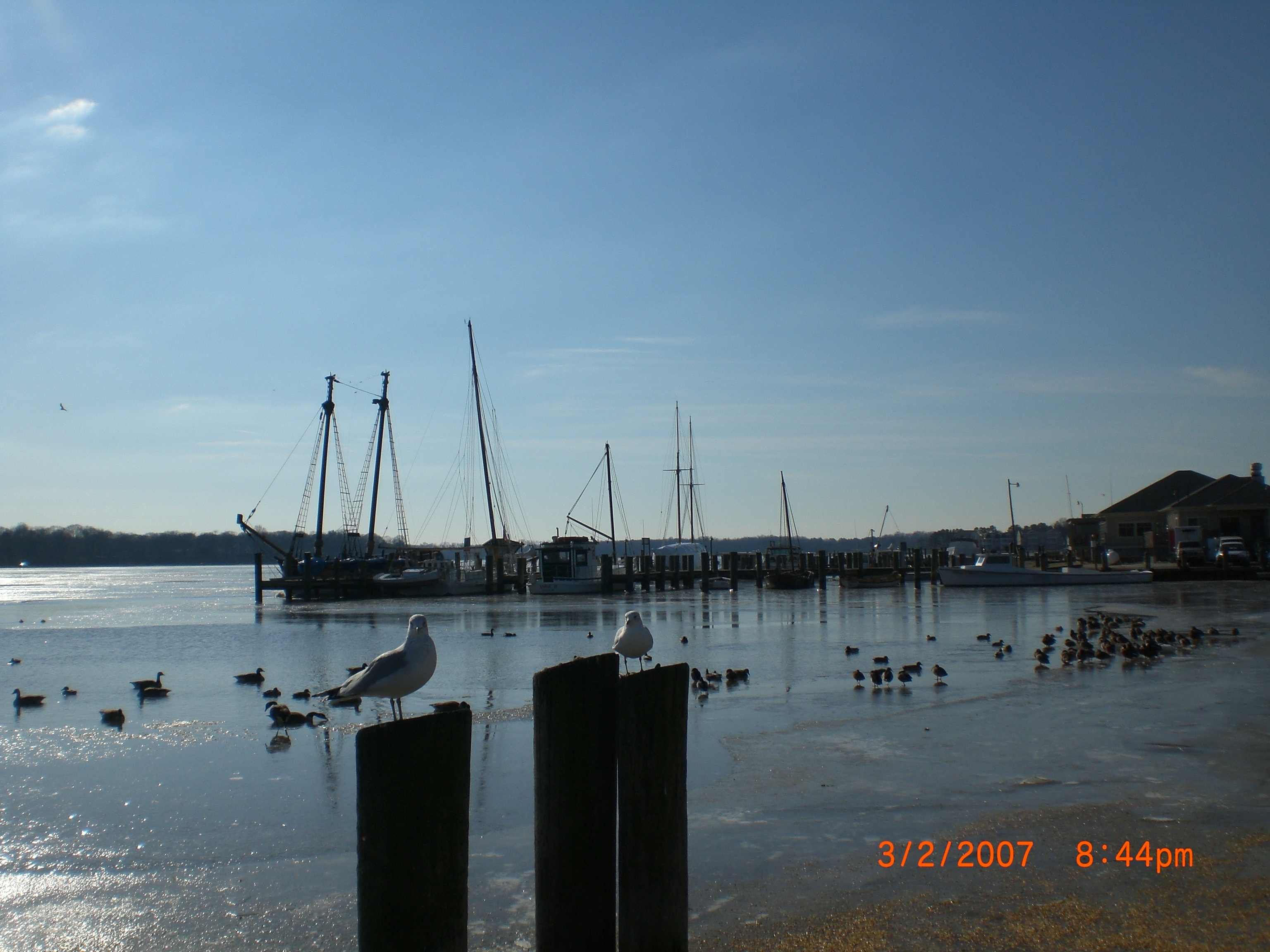
 I have taken this photograph (of the friendly seagulls) in Chestertown, Maryland a few years back during my high-winter visit to the Great Oak Manor Inn.  As for the poem below, I wrote it under the spell of my entire experience there.

hours of road monotony

the GPS – self-imposed dictatorship

tired, bored, no more beauty in the snow

then…

a private gateway,

a much anticipated spectacle:

The Inn.

A compelling magnificence.

No need for a color, shade, or a hue;

a winter embrace of splendor;

the smolder of her fireplace…


I feel  home.


Spacious beyond the eye’s territory,

not at all an inn of limits;  

high-risers’ luxury at hand;

many may deem impersonal,

out of futile habit: This, a B&B?


I feel home.


Eloquent, the host – the hostess, of elegance.

The puppy acts like one yet outsizes me.

Struck by grave illness, the eldest feline

each night in my Victorian space.

She, too, will break hearts, never to replace the pieces.

Just like my Russian Blue, Duman.


A mere three days’ span…

listening

inhaling

seeing

the authentic self

outside its tested and testing

fragmented, fragmenting

judged, judging

rushed, rushing

shell-self.


I am home.


2 Comments

Filed under Poetry, Reflections

Cemal Süreya

cemalsureya

Have you ever had any moments when you wished to have met an individual no longer alive?  This desire seems to be visiting me often, and in particular, when poets, writers, and thinkers are concerned.  It happened again when I watched the following recording from the post-60s Turkish television archives:


By giving me a sweet surprise from his grave – his laid back wittiness, Cemal Süreya immediately appealed to me as my focus for this November Wednesday.  While live on television to talk on the state of literature in the country, the program host asks the poet the issue with the infamous misspelling of his last name.  (When spelled with double “y”, it mostly identifies a woman in Turkish.)  Süreya replies in polite indifference: “I lost a bet.  About twenty years ago.  Since I had two of them, I didn’t mind giving away one of the ‘ys’.”

I also wanted you to have a taste of one of Süreya’s perhaps most frequently cited poems, “Aşk” (Love) in its original language.  For that, I am resorting to yet another video recording, in which Bülent Yakut delivers an utterly successful reading:


As for the poem I have selected to translate for you from many of Cemal Süreya’s lyrical collections, it highlights a rare find as far as the subject matter.  The original version in Turkish appears first, as it has been my practice all this month:

Afrika dediğin bir garip kıta

El bilir alem bilir

Ki şekli bozulmasın diye Akdeniz’in

Hala eskisi gibi çizilir

Haritalarda

An amazing continent, this Africa

Strangers know it the universe knows it

That it is drawn on maps

as it used to be

not to blemish the shape of Mediterranean Sea

Leave a comment

Filed under Reflections

Can Baba (Can Yücel)

Can_yucel

Continuing on my nostalgic November trip to the writers’ and artists’ circles in Turkey, I want to introduce you to Can Yücel, a poet to whom many biographers refer as “Can Baba” – Father Can (non-religious connotation).  His poetry stands out with his use of colloquial Turkish, thus, making poetic compositions a product for the masses.  The video below demonstrates a flawless reading performance of one of Can Baba’s most popular poems – “The Most Beautiful Part about Being with You”:

For my translation, I have chosen a different poem by Can Baba, namely his “Hayal Oyunu” – “A Play with Imagination”:

Hayal Oyunu

Ellerindi ellerimden tutan
Ellerimdi ellerinden tutan…
Bıraktığı anda ellerimiz ellerimizi
Gökyüzüne vuracaktı gölgeleri ellerimizin
Kimbilir kaç martılar halinde

Bir masada karşı karşıya
Seyrederken dudaklarını senin
Dile gelmiş ilk Türkçeydik
Henüz başlamış kül rengi bahar
Ne savaş, ne barıştık biz…

Bu dünyaya yeni gelmiş bir diyar
Manolyaya gece konmuş kumrular…

A Play with Imagination

It was your hands holding mine

Mine, holding yours…

The shadows of our hands were going to hit the sky

As soon as our hands left our hands

Who knows? In the form of how many sea gulls

//

We were the first spoken Turkish

While I was beholding your lips

At a table, across from one another

We were the newly setting smoke-colored spring

We were neither war nor peace…

//

A realm newly born in to this world

Doves, perched on the magnolia in the night…

~ ~ ~ ~ ~ ~ ~ ~ ~ ~ ~ ~ ~ ~ ~

I hope you have enjoyed your visit this Wednesday.  I look forward to you stopping by next week again but also for your visit to my Sunday Reflections.

2 Comments

Filed under Reflections

Özdemir Asaf and Yıldız Moran Arun

For the month of November – my most favorite autumn time, I will make a virtual visit with an artist or a writer (or both, as is the case today) of my country of birth.  Why Turkey?  Why now?  Well, I have reached and fast passing the autumn of my life and have begun to feel an increasing nostalgia toward the world corner where I first joined the living.  November is marked for us in the U.S. as the month of thanksgiving.  It is my way of giving thanks to my birthing place in this manner.  And I just would love it, if you were to join me on that travel for a little longer…on Wednesdays…and only for a month…


The video above vocalizes a reading of “Yalnızlık Paylaşılmaz,” one of the many poems on loneliness by Turkey’s widely reputed poet, Özdemir Asaf – Halit Özdemir Arun, with his real name (1923-1981):

Yalnızlık, yaşamda bir an,

Hep yeniden başlayan…

Dışından anlaşılmaz.


Ya da kocaman bir yalan,

Kovdukça kovalayan…

Paylaşılmaz.


Bir düşünde, beni sana ayıran

Yalnızlık paylaşılmaz

Paylaşılsa yanlızlık olmaz.

Loneliness, an instant in life,

Always occurring anew…

An enigma from the outside.


Or, a colossal deceit,

One that chases the more it is chased…

Cannot be shared.


Saving me for you in one of your dreams

Loneliness cannot be shared

If it could, it would not transpire.

(My own translation, as of 10.29.2013)

Özdemir Asaf – with his best-known name, is considered a prominent landmark when contemporary Turkish literature is considered, not only for his poetic work in his native tongue but also for his translations from French poets and writers in journals and anthologies since 1940.

Yıldız Moran Arun (1932-1995), the poet’s wife was Turkey’s first professionally trained female photographer.  An article in Kadınlar Gökkuşağı claims that – while on one single day, 25 of her photographs were purchased in Cambridge; Moran’s photographic art was overlooked in her country of birth, Turkey, despite its popular appeal.  Her accounts on how she met her husband count as some of the most critical representations of Özdemir Asaf in his true light.

The poem below constitutes one of the poet’s perhaps most passionate verses on loneliness, with my English translation following immediately:

Sen herşeyi süpürebilirsin; sonbaharı süpüremezsin
yalnızsa sürekli bir sonbaharı süpürür hep..

Düşünemezsin.

Yanar sobasında yalnız’ın üşüyen bakışları.
Lambasında karınlığa dönük bir ışık titrer sönük-sönük.
Penceresi dışına kapanmıştır kapısı içine örtük.

Yalnız bin yıl yaşar kendini bir an’da.

Yalnız’ın nesi var nesi yoksa tümü birdenbire’dir.

Yalnız bir ordudur kendi çölünde..
Sonsuz savaşlarında hep yener kendi ordusunu.

Yalnız’ın sakladığı bir şey vardır;
Boyuna yerini değiştirir boyuna onu arar… Biri bulsa diye.

Yalnız hem bilgesi hem delisidir kendi dünyasının.
Ayrıca; hem efendisi hem kölesidir kendisinin.
Tadını çıkaramaz görece’siz dünyasında hiçbirisinin.

Yalnız sürekli dinleyendir söylenmemiş bir sözü.

Sözünde durması yalnız’ın yalancılığıdır kendisine..
Hep yüzüne vurur utancı. O yüzden gözlerini kaçırır gözlerinden.

Yalnız’ın odasında ikinci bir yalnızlıktır ayna.

Yalnız hep uyanır ikinci uykusuna.

Yalnız kendi ben’inin sen’idir.

Bir sözde saklanmış bir yalanı bir gözde okuduğundan
bakmaz kendi gözlerine bile.

Her susadığında o kendi çölündedir.

Kendi öyküsünü ne anlatabilen ne de dinleyebilen.
Kendi türküsünü ne yazabilen ne söyleyebilen.

Bir zamanlar güldüğünü anımsar da…
Yoğurur hüzün’ün çamurunu avuçlarında.

Yalnız aranan tek görgü tanığıdır
yargılanmasında kendi davasının..
Her duruşması ertelenir kavgasının.

Yalnız hem kaptanı hem de tek
yolcusudur batmakta olan gemisinin..
Onun için ne sonuncu ayrılabilir gemisinden ne de ilkin.

Yalnız’ın adı okunduğunda okulda ya da yaşamda..
Kimse “burda” deyemez.. Ama yok da..

Uykunun duvarında başladı..
Önceleri bir toz gölgesi sanki; sonra bir yumak yün gibi.
Ama şimdi iyice görüyor örümceğin ağını gün gibi.

Yalnız duymuş olduğunun sağırı görmüş olduğunun körüdür..
Ölür ölür öldürür.. Öldürür öldürür ölür.
Duyduklarını unutur duyacaklarını düşünür.

Yalnız’ın adına hiç kimse konuşamaz..
O kendi kendisinin sanığıdır.

Yalnız önceden sezer sonra olacakları..
Paylaşacak biri vardır; anlatır anlatır ona olanları olmayacakları.

Her leke kendisiyle çıkar.

You can sweep everything; but not the autumn

lonely*, however, sweeps the fall all the time…

You cannot imagine.


The freezing looks of lonely, inside its burning stove.

A dim light shivers toward the darkness in its lamp.

Its window is shut to the outside; its door, closed to its inside.


In an instant, lonely lives itself a thousand years.

Whatever lonely owns, they all amount to all at once.

Lonely is an army in its own desert…

Always defeats its own army in eternal wars.

There is something lonely hides incessantly;

It changes its location, quests for it incessantly…For someone to find it.


Lonely is both the wise and the mad of its own world.

Moreover; the master and the slave of itself.

Can’t savour any of them in its futile world


Lonely constantly listens to an unspoken word.

Keeping its promise is its deception of itself…

Its disgrace always tells it off.  It therefore avoids its eyes from its own.


In lonely’s room, the mirror is a second loneliness.


Lonely always wakes up to its second sleep.

Lonely is the you of its own I.

For it once read a lie in an eye hiding in a word

it won’t even look in to its own eyes.

When it thirsts, it is in its own desert.

Can neither tell its own story nor can it listen to it.

Can neither write its own song nor can it sing it.


Though it will remember its once upon a smile…

It will knead the sorrow’s mire in its palms.

Lonely is the only witness searched for

in the trial of its own case…

Each hearing of its quarrel, postponed.


Lonely is the captain as well the sole

passenger of its own sinking ship…

It thus can neither leave it last or first.


When its name is called in school or in life…

No one can say “here”…But neither “away”…

It began on the verge of sleep…

As if a dust shadow, first; then, a ball of yarn.

But now, it clearly sees the spider web as clearly as day.

Lonely is deaf to what it had heard; blind to what it had seen…

It dies and dies then kills…it kills and kills then dies.

Forgets what it hears; thinks of what it will hear.

No one can speak on lonely’s behalf…

It is its own accused.


Lonely foresees what is yet to happen…

It has someone to share it with; tells and tells all that happened all that won’t take place.

Every defect removes itself with itself.

 (My translation as of 10.29.2013. *Özdemir Asaf transforms the adjective “lonely” in to a noun in Turkish.  I have honored the grammatical freedom he takes in this poem.)

~ ~ ~ ~ ~ ~ ~ ~ ~ ~ ~ ~ ~ ~ ~ ~ ~ ~ ~ ~ ~ ~ ~ ~ ~ ~ ~ ~

I hope you enjoyed this autumn Wednesday with me during my virtual visit to an artist and a writer of Turkey.  I very much look forward to another November Wednesday but first, to Sunday when we will meet here again.  May you have a wonderful of everything in the meantime.

Leave a comment

Filed under Reflections

A bright light

1045050_572968926087231_376921513_n

a loved one’s long lost scent

the surprise of an aromatic flow

a place i may never get to better know

houses my original self

having waited for me understood it somehow

though years of travel days of distances away

unchains with softest touch its trapping turmoils

spreads before it the most welcoming skies

breathes for it soothing breezes of air

oceanic waters of ebbs and tides

unpredictable yet donned in magnetizing beauty

traces the devotion of forgiving patient friends and family

i live

re-live

and live again

from readers writers thinkers alike

for long on a throne of their own right

i cite

re-cite

and cite again

for all constitute a rope from a well about to expire

the wish to die thus does not easily stay alive

the light’s name has always been Sinopem for me

my ashes await to be spread there to the sea

its incomparable warmth was all i could wish for or plea

in approach of the cold darkness of dark moments yet to see

i finally can take it to my heart as well my head

the many a things i must still do that lie ahead

for my love of family and friends, in no doubt

however also for others i care deeply about

a very young man from the fresh recent past

opened my eyes to a distinct value at last

has shaken my self to an unselfish role

lending it sense to his potentials galore

born with no privilege living that way, too

i, however, made and today make better due

yet most i sorrow over has been my own woe

this tale though is none about me or my ado

he lives too far away, i may never see him be

i would like to see his sweet smile right before me

what’s more vital, however, is for me here to tell

the life impeccable poetry shapes onto his cell

with each of his words’ ever growing legacy

how his wisdom pours out of his essence

after a mere twenty years of existence

lacking the luxury of a computer unlike you and i

his poetic charm stuns his own words of innate music

assembles them on broad canvas of a rare refined gift

destined to soar in peace over peaks ever so high

he has just birthed The Lightbearer, a collection of verses

dedicated ardent loving are this special soul’s admirers

my dire hope is you, too, will pause a moment to heed

to see for yourself what he offers to forever breed

Kolade is his name, Olanrewaju to add

Freedom is the epithet he was meant to have had

Sinopem remains a light to me still

it will continue to be to delightfully thrill

the radiance from Kolade Olanrewaju Freedom

emanates a glow though beyond unfamiliars afar

settles it gently in to this fast aged heart

determined a little while longer to trill

hülya n. yılmaz, 10.12.2013

~ ~ ~

Kolade Olanrewaju Freedom  has been invited by the National Library of the Philippines Historical Forum 2013 to receive an award for his positive contribution to humanity through poetry.  Unfortunately, due to lack of funds he won’t be able to attend the ceremony where he would have been recognized in person as one of the honored poets worldwide.

~ ~ ~

With permission from this young poet, please find below his life story in his own words:

“I was born on the 23rd of December, 1993 in Osun State, Nigeria.  I attended my primary school at Merry Kiddies Nursery and Primary School Lagos State, Nigeria where I graduated with an excellent result.  I moved on to secondary school otherwise known as high school at Federal Government College, Ikirun.  I was in the Science department, and I had my O’level result there.  After leaving high school, I realized Science was not my passion, I studied science due to my fascination for it and also to impress others.

In my quest to satisfy passion and refine my talent, I started tutoring myself as an art student.  I taught myself literature, government, c.r.s etc.  After this, I sat for another O’level exam conducted by W.A.EC G.C.E and to my amazement, I passed all my Art subjects exams.  It was during my personal study as an art student that I encountered the gift of writing poetry, and so far, I have contributed in International anthologies like United We Stand (U.S.A) April Rains (U.S.A) Twist of Fate (U.S.A) and Heavens above Poetry Below (Canada) etc.

My two poetry books will also be published before the year ends with Nevermore Press and Inner child press (Chap book) both in the U.S.A.

I intend to study either literature or creative writing in college if offered a scholarship.”

~ ~ ~

The electronic platforms to meet Kolade Olanrewaju Freedom and his newly published book, The Light Bearer:

Facebook Author Page

Facebook Personal Page

Twitter Account

blog site

The Light Bearer – Kindle

The Light Bearer – Paperback-related Facebook Event


2 Comments

Filed under Reflections

In good company

As I do when I teach the undergraduate literature course – to help my students see beyond the inaccessibility of classical writers, I called for my imagination also for today.  I let it transfer me to the times of three such well-known literary names: Robert FrostFlannery O’Connor, Ray Bradbury.  The reason beyond the urge to gather a virtual literary circle to connect in one form or another (no ghost-calling séances here) to writers no longer living was not the course in question this time.  I had been working on a poem of loss part of last week.  Prior to that work, I had completed a short story centering it around the crime of honor killing.  Severe sadness had set in after both processes.  In moments like these, I tend to prefer not to bother my daughter or a friend.  I seek comfort in penned emotions of writers from a seemingly spectacular past.  The following words gave me the calm I had been seeking to achieve this time.  Not because they define joyous feelings but rather thanks to their affirmation of the one specific human state that motivates us to write – sadness in face of reality.  There are going to be other phases when I end up feeling the pull of sorrowful moments again.  And again.  Also then, I know, other penned words will come to help me ease them.  To reassure the reality of life is here to stay with its highs and its ills.  Here are the famed authors to state what we, too, experience day in, day out.


07bradbury2-span-articleLarge

[Ray Bradbury (1921-2012)]

“You must stay drunk on writing

so reality cannot destroy you.” 


[Flannery O’Connor (1925-1964)]

Flannery-Oconnor-9426760-1-402

“Writing a novel is a terrible experience during which the hair often falls out and the teeth decay. I’m always irritated by people who imply that writing fiction is an escape from reality. It is a plunge into reality and it’s very shocking to the system.


???????????

“A poem begins with a lump in the throat; a homesickness or a lovesickness. It is a reaching-out toward expression; an effort to find fulfillment. A complete poem is one where an emotion has found its thought and the thought has found words.”


[Robert Frost (1874-1963)]


Robert Frost [Quote]

Flannery O’Connor [Quote]

Ray Bradbury [Quote]

Leave a comment

Filed under Reflections

If I don’t, if you don’t, if s/he doesn’t…

Nazıms question

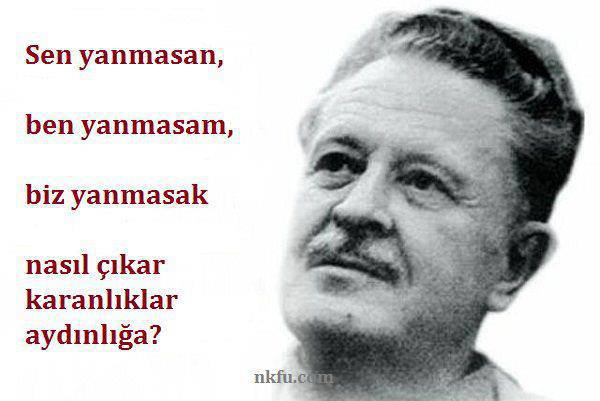
What Nazım Hikmet, the world-renowned exilic poet and thinker of Turkey stresses in his call for collective strength in harmony,  is as follows: “If you don’t, I don’t, we don’t blaze, how can the darkness emanate light?”

Nazım’s invitation, to me, is one to awareness – a timeless gift to generations to come.  If they were to be willing to listen to it, of course.  No different than what John Lennon intended with his song, “Imagine”:

The following lyrics – in sync with the rest of the song, seem self-explanatory:

“[…]

Imagine there is no countries

It isn’t hard to do

Nothing to kill or die for

And no religion, too

Imagine all the people

living life in peace […]”

These remarkable visionary individuals are no longer among us.  We, however, are.  I, for one, have found my niche in the sharing of my awareness for this vital thought processing among the living: love for world peace – one I have been yearning for very long.   It came to me thanks to the World Healing World Peace Poetry Anthology 2014 initiative by Inner Child Press.

Please know I am writing about this marvelous project not at all because I happen to have a submission of my own.  I don’t.  I won’t.  If I had or were to plan to do so, I would have to step back.  Here, I mean.  For I have strict self-imposed rules regarding self-promotion.  And, you all know how I treat my own work contribution – as you have seen my quite subdued announcement of my poems in an anthology by another publisher.

The conceptualization of world peace by the Inner Child Press is simply me finding home.   Through collective poetry creation in order to attract attention across the world, spanning over the boundaries of countries.  What a thought!  In order to lend a long overdue balance against the power of  violence – a trait of our  world that has enjoyed dominance for way too long.  But, that, is a learned trait.  How can it stand – we may respond with a false sense of confidence –  against the strength of love, an inborn asset of each human being?  It can.  It unfortunately can.  And it does.  It has.  It will.  As long as we keep letting it.

Peace in love.

“Poetry is what happens when nothing else can.” – Charles Bukowski  (Source)

2 Comments

Filed under Reflections

A memorable international charity anthology and my two-poem contribution

ToFNewCoverFrontSmaller

Where to find our published work of whose sale outcome will 100% benefit the victims of the May 2013 tornado in Oklahoma via May Tornadoes Fund processed by United Way.-

Amazon Kindle Edition

Barnes and Noble Nook Book

Smashwords

For Paperback –

createspace


All proceeds are donated to the May Tornadoes Relief Fund,

administered by the United Way.

Leave a comment

Filed under Poetry, Reflections