Dr. Kiriti Sengupta (Calcutta, India), interviewing contributing poets, writers, and artists for the soon-to-be-published global Twist of Fate anthology conceived and materialized by Indies In Action.
Hi Maria !! Greetings from India. This is Kiriti. I must thank you for your contribution towards the international charity anthology, Twist of Fate. I seriously wish to ask you few things, if you, please.
Maria: By all means.
Kiriti: You have contributed ISBN towards the anthology. Would like to know what the significance of the ISBN is and how it would help in establishing the work (book).
Maria: The International Standard Book Number (ISBN) is a unique numeric commercial book identifier to help booksellers identify individual books. Most booksellers will not accept books without this number. That alone speaks to its availability and marketability.
Kiriti: Why did you come forward with this unique idea of donating the ISBN to the anthology ?
Maria: Everything Stephen L. Wilson and this anthology stands for is…
Decades ago, I have taken a picture of my former husband in a similar pose as the man featured above – with our daughter, our only child. Such images are not rare to run into – in hard copy or digital form. We often make the mistake of equating that tender moment’s capture with a lifelong promise of unconditional acceptance, respect and love for the newborn child. Time only tests whether that precious and most important call is, in fact, honored by each parent. Whether unconditional love prevails.
My point of interest, though, is not at all my daughter’s father but rather my fathers. No confusion, please: I have only one biological father. He is turning 87 this year. He has been good to me. He still is good to me. Babalar Günü’n kutlu olsun, babacığım!
Then there is my uncle-dad. My mother’s older brother – the only surviving sibling out of three. It is to him I dedicate my post today. For always being by my side – although a continent away; for giving me strength through my small hurdles or most trying ordeals; for having proven to me time and again what I have been hearing him tell me since the age when I finally realized his presence: “you are my daughter also”; for worrying about my health while still in the hospital after his emergency surgery following an almost fatal internal bleeding; for never leaving me out of his caring soul even during his life-threatening conditions – not only during the first, or the second but also after the third kind of cancer’s attack.
I have hesitated for a long time before posting this plea to you. My sense of judgment, outrage at violence, especially, when unprovoked, love for humanity brought me to my senses along with my conviction that we all may one day end up in a similar state of being, when information becomes a must toward helping others who are being subjected to government-ordered brutality and absolute censorship. Hence, my post.
The situation in Turkey is getting worse, in that that the government ups its forces and violence and is not keeping it a secret. Tomorrow has already dawned in Turkey, very soon the UNARMED protesters will be facing the violent (not to stop the people but to hurt in any which way they can), brutal (if chemically mixed pressured water won’t hurt as much as they like, one on one hits with whatever they have on them, which is always the most compared to the protesters who have nothing), merciless (no age group is immune as the reports keep coming in). Some call this “civil war”, including Turkey’s current prime minister who caused all this division to the nation but bear in mind: It can’t be civil war, for only one side is armed. His. It has been already quite a suffering to which he objected his own population thus far already but June 16, 2013 – tomorrow/today in Turkey may and most likely will get worse. It is father’s day. From the outset of his political journey, aiming to erase not only the name but all history of and about Mustafa Kemal Atatürk, called affectionately THE FATHER OF THE TURKS since 1923, the said prime minister is claimed to have planned to do everything in his power to cast for that role once and for all. Please be aware with regard to the most time-tested English-speaking international news coverage (Christiane Amanpour is a best point to start) to the best that you can and spread the word. There is no Turkey-based English news coverage to which I can refer you at the moment (and most likely for a long time to come), as the reliable ones are either shut or going through governmental investigation. I refuse to play into your emotional side and am therefore not posting anything visual or audio-captured, whether overly disturbing or not. Nor will I ever do here. My heartfelt thanks for listening to me.
İstanbul’un göbeğindeki küçük bir parkın ticari amaçlarla tahrip edilmesi gibi bir yerel meseleden kaynaklı gibi görünse de, Türkiye’de devam etmekte olan protestolar açıkça çok daha derin bir öfkeye işaret ediyor. Bu öfkenin yaygın bir şekilde, “ılımlı İslam” ülkesi modeli olarak algılanan, hızla gelişen bir ekonomiye sahip bir ülkede patlak vermesi, hastalığın nedenlerini de: vahşi neoliberal ekonomi ile dini-milliyetçi otoriterliğin kaynaştırılması girişimi. Bu iki sürecin de kurbanları aynı: Bağımsız sivil toplumun dayanışma ruhu ve kültürel hoşgörüsü; bir ulusun ahlaki sağlığının belkemiğini oluşturan ruhun ta kendisi. Buradan da anlıyoruz ki bu protestolar, serbest piyasanın toplumsal özgürlük anlamına gelmediğinin, ancak otoriter politikalarla bir arada bulunabileceğinin canlı kanıtıdır. Bu protestoların neden dünya çapında kurulu düzeni sarsan aynı küresel ajitasyonun bir parçası olduğunun da göstergesidir bu. Özgürlük ve kurtuluşa önem veren bütün insanlar, Türkiye halkına “Hoşgeldiniz!” demelidir. Şimdi aynı küresel mücadelenin parçalarıyız. İspanya, İsveç, Yunanistan, Türkiye… Ancak yan yana mücadele edersek bir şansımız olacak!
What can penguins, pots and pans, jazz, folk music, police, Allah, a woman in red, gas grenades, nail polish, Noam Chomsky, children, alcohol consumption, family values, Turkish Airlines, red lipstick, possibly have in common?
If you are as puzzled now as I had been on May 30, 2013, then we are in good company for each other, when it comes to my attempt today to help us all understand and make sense of what has been happening in Turkey since.
It all began in Gezi Parkı, in Taksim, İstanbul with a hard core female terrorist. Please, heed particular attention to her white bag over her right shoulder and her left hand. You, too, will be convinced as to what type of destructive acts a ‘Woman in red’ is capable of:
The country’s unarmed, unprepared police force has, thus, suffered first in this heavily armed woman’s hands, as we all saw in the news coverage above; then, they were attacked by other terrorists:
Turkey’s current prime minister knew of the peaceful march initiated by his unarmed citizens to raise awareness for their rights to Gezi Parkı in Istanbul’s Taksim quarters, their public space since the founding of the Republic of Turkey in 1923. Standing by his public alone, he did all in his power to help raise awareness and nation-and worldwide support for their actions. The significance of the park – other than its ancient old trees, benches, strolling paths offering the only natural haven in the middle of one of the world’s largest cities, was, after all, apparent to everyone who had basic knowledge about modern Turkey’s historical and cultural past. He, too, didn’t want any drastic steps erasing the city’s post-Ottoman Empire landscape. He, too, knew bulldozing this park would be unforgiveable. Therefore, the night of the first day of the protests by thousands of his people across the country, he ordered CNN-Turk – the nation’s primary source of information, to contribute to the spreading of the word with a penguin documentary . At the risk of becoming a source for mockery inland and abroad.
The protesting citizens just didn’t and wouldn’t appreciate his good intentions, or what he meant by his reference to them as çapulcu and “terrorist”, and their actions, “tencere tava, hep aynı hava” (“pots and pans, the same tune as always”). First, a few among them but then in growing numbers, were so unthankful that they composed folk music using pots, pans and other everyday items, now known as Tencere Tava Havası:
Then, students from Bosphorus University, one of the oldest and most prominent higher education institutions in Turkey, had the nerve to form a jazz ensemble, following in the footsteps of their pots-and-pans-musical counterparts:
Why did at least the half of his public end up with unrest that has been going on as I am writing? Despite the killings, being subjected to indiscriminate, horrific injuries, the debilitating blows to the face to take the eyes out, and other horrendous crimes against their rights to live as a human? After all, it is not that the Turkish prime minister has been tyrannizing the thinking, analyzing, alert population among his public with his multiplying, human rights-disregarding decrees of random conception, like his call for three children.
Why not abide by his iron fist that falls onto everyone’s bedroom scene and bring into his world for his sake a minimum of three children?
And what about this obsession of the same population with alcohol consumption? After all, drinking even a mere cup of wine –however occasional or frequent that may be, equates alcoholism.
Oh, then there is red lipstick! And, nail polish! Every woman not only in Turkey but in the rest of the world would be much better of living without the red and the polish.
~ ~ ~
Let me, at this point, lend these events the somber tone they deserve in any re-narration. And mine won’t be an exception. (Not that I can think even for a minute you having taken me seriously throughout my preceding notes of dark humor.)
Amnesty International calls for prompt action against the use of “brutal police repression” and for ‘investigation’ of “abuses” in the “İstanbul protest”. A Reuters article, then, sums up how Turkey’s prime minister invokes Allah, demands protests end immediately.While routinely ordering his police to conduct their violent attacks on his own unarmed and peaceful public, in full knowledge of the ensuing consequences of senseless human suffering, he “invokes Allah”.
What has Allah to do with brutality against fellow human beings? Defenseless, at that? In a May 29, 2013 interview about the murder of a British soldier, Imam Ajmal Masroor (an imam is the head of a Muslim community) answers the question as clearly as can be: Nothing.
Though unrelated to the violence-inclined Allah invoking Turkish leader – Imam Masroor asserts in angry disbelief repeatedly how killings don’t belong in the Kuranic teachings (Kuran as the Holy Book of Muslims):
For the time being, it is the people of Turkey who need our fact-based knowledge about what is taking place in their part of the world. Tomorrow, it will most certainly be in a different segment of our planet. For greed, lust in and abuse of power, violation of human rights, brutality, the killing of the innocent does not solely a Turkish agenda make. In heart-felt empathy for but unfortunately geographically distant collaboration with those who presently suffer or may be subjected to suffering within their own country’s borders at another point in time, I end my words with a call to the world byNoam Chomsky in support of the Gezi Parkı Resistance:
The only time I was close to being drunk was in my very early twenties, among my parents, next to my fiance. It was a lovely summer evening in Ankara, Turkey, where I finished schooling as he had. He and I were enjoying our corner in the balcony of my parents’ living room over a cup of wine. I remember becoming overly “happy” – for which there is a different term, I know. What I could have possibly seen as problems back then, had left room for much laughter, most, originating from within me, not at a joke or teasing. I could use that innocent joy today, for days to come, for that matter. Don’t get me wrong: There is a wonderful factor outside me that makes me very happy, in fact. I only mean for myself, once I close the door to my home, leaving myself behind any and all aspects of the outside world (minus the e-connections). New realizations today make me long for a sense of being sedated. Hence, the reason as to why the following quote has gotten its place here right now. Thank you, Ray Bradbury! Thank you, dear reader, for listening!
The video below shows Elzara Batalova , of Crimean Tatar background, singing “Ey Güzel Qırım” (“Oh, You Beautiful Crimea”), a ballad in one of the many Turkic languages :
Hers is a song of nostalgia, of the passionate longing for home, as the following refrain – one of several – articulates:
I haven’t lived in this place
Haven’t been able to realize my old age
Have been yearning for home
Oh, you beautiful Crimea
I don’t know how many of you have been born outside the United States, neither do I have any insight into whether you miss your birthplace – no matter where it is. As some or maybe all of you already know (About), I was born and raised in Turkey and lived there until the age of twenty-four. Although, my move to North America is not about a migrant’s story, an opinion page in New York Times on immigrants and the overall global trend to leave home recently got my attention. Unlike some other articles I had encountered over the thirty-six years I lived and worked in the States, the treatment of this issue by Dr. Susan J. Matt , a professor of history at Weber State University – and the author of Homesickness: An American History , is psychology-based. The facts, figures and statistics, I will leave behind. Should the topic appeal to your interest, you can easily locate the source (in myblog roll).
Based on her “nearly a decade’s research” on the subject, Prof. Matt first informs us in “The New Globalist Is Homesick” as follows: “The global desire to leave home arises from poverty and necessity, but it also grows out of a conviction that such mobility is possible.” She then adds that “it also has high psychological costs” and that “many people who leave home in search of better prospects end up feeling displaced and depressed.” Foremost important to me on a personal level is what she states next:“Few speak openly of the substantial pain of leaving home.” We learn from her article how in the 19th century “[s]tories of the devastating effects of homesickness were common [… (e.g.] ‘Victim of Nostalgia: A Priest Dies Craving for a Sight of his Motherland.”) What the article highlights next is, to me, a first-time fact: “Today, explicit discussions of homesickness are rare, for the emotion is typically regarded as an embarrassing impediment to individual progress and prosperity. This silence makes mobility appear deceptively easy.”
Here, I invite us to pause briefly in order to get into my head, approximately three decades ago: At a time, when I was craving to be back home. My mother was the main reason for my longing, along with my youth love I had left behind. With the exception of my letters to her and a few jotted notes, I, too, had kept my silence about the deeply rooted ache I used to feel. With my mother’s death, my letters also vanished. As for those scattered notes, I may eventually find them during another move, whenever that may happen. Imagine now, if you please, my conditions to leave my home country as opposed to those Matt analysed: There was no necessity for me to leave my home country. I left to pursuit my passion to further my studies. Poverty was not an issue, either. Still, during my first years here, I experienced feelings of immense loss.
“Technology also seduces us into thinking that migration is painless [,]” writes Matt and argues: If today’s ways of rapid communication “could truly vanquish homesickness and make us citizens of the world, Skype, Facebook, cellphones and e-mail would have cured a pain that has been around since ‘The Odyssey’.” She also announces: “Homesickness continued to plague many who migrated.” Her argument finds support in her own research of the Archives of General Psychiatry, regarding, for instance, the “rates of depression and anxiety” among “Mexican immigrants in the United States” being “40 percent higher than nonmigrant relatives remaining in Mexico. A wealth of studies have documented that other newcomers to America also suffer from high rates of depression and ‘acculturative stress’.” Matt ends her findings by stressing how limited “the cosmopolitan philosophy” is: “The idea that we can and should feel at home anyplace on the globe is based on a worldview that celebrates the solitary, mobile individual and envisions men and women as easily separated from family, from home and from the past. But this vision doesn’t square with our emotions, for our ties to home, although often underestimated, are strong and enduring.”
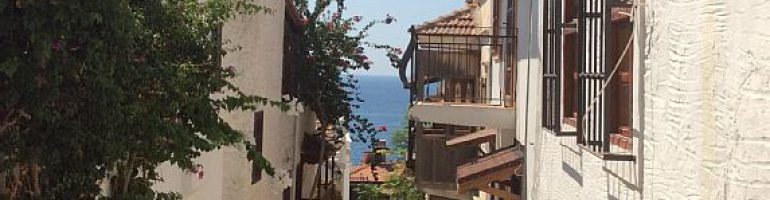
On a personal level, I admit to a realization at this stage in my life how strong and enduring my ties to home have, in fact, been. When I say home, it is not even my birthplace I speak of. It is, rather, that of my mother and of seven generations on her family side. When the name alone comes up – Sinop, the small harbor town that housed Diogenes, I face the oddest phenomenon of my entire life so far: A primal urge to be there. Since I can’t, I have scenario-rich dreams about it; I composed one, to me one of my most illustrious and longest but also most meaningful poems for it; I lived the most exhilarating three-and-a-half months of my life in it; I mourned and continue to mourn the loss of my mother’s inheritance from it. I have even gone to such extent to add to my living will for my ashes to be spread to its sea.
I believe to no longer underestimate my ties to home – the way I had been for long , neither do I undermine the fact how strong and enduring that connection can be. As if our umbilical cord is still attached not only to our mothers but to our birthplaces at large as well.
I now end here with the hope that you will come back, perhaps even with your own story of leaving home, or, just because. Before I do, however, I want to give you “Sinop Aşkı” (“Love of/for Sinop”), a short video (4:37) with still images of the town, accompanied by modern Turkish Folk music. The second video is a longer and live introductory piece in English (25:16). We have started with a music piece. Why not end on one.
For many people, expressing feelings verbally can be difficult; opening up to someone on a particular topic can cause feelings of vulnerability. In this instance, writing serves as a way to be able to express certain feelings through a creative outlet. Writing unlocks your subconscious to bring to light your most pressing thoughts, from current issues at hand or those from the past that you have been avoiding.
The therapeutic effects of writing have been so effective that it is frequently encouraged in the hospital setting for those who are physically or mentally ill. Counselors who have patients who have experienced traumatic events often encourage those patients to use writing as a form of therapy. Suppressing your thoughts is stressful to the body as well as the mind. When you sit down and write, you are taking time to take care of yourself. Instead of…




 hülyaswritings