Please accept my thanks for your visit to my blog site. I am sorry for the lack of any reflections today. Once a year, on the occasion of my birthday, I will allow myself only private deliberations and starting on Friday, this weekend marks one of those occasions. I look forward to your visit next Sunday!
Category Archives: Reflections
Foreign Language Teaching in U.S. Universities: An Instructor’s Perspective
A mid-November 2012 Princeton University announcement of a lecture by the widely published professor of German, Claire Kramsch has attracted my attention as another semester committed to the teaching of German is coming to an end for me next week. The background information on this academic event sums up critical issues in the field that the Modern Language Association of America highlights and analyzes in its report from five years ago:
“The influential 2007 MLA Report ‘Foreign Languages and Higher Education: New Structures for a Changed World’ calls for the development of ‘translingual and transcultural competence’ in foreign language education. This competence, which would replace the goal to achieve the competence of an educated native speaker, aspires to provide students with ‘the ability to operate between languages’, ‘to function as informed and capable interlocutors with educated native speakers in the target language’, and ‘to reflect on the world and themselves through the lens of another language and culture’.”
Let us consider at this point an answer to a critical question: What are the classroom realities for the teaching of a foreign language (in my case, German) for an instructor in a non-tenure-track position – of whom the MLA report in question speaks in the section titled “Transforming Academic Programs”? With the current standard (at my university) of three-courses-a-semester teaching load, the teaching-learning exchange amounts to a significant dilemma (times three). For the number of students even in specialized language courses – one with its sole focus on listening and speaking and another, on reading, writing and grammar, i.e. those that have the best potential to provide learners with the ability to achieve the goals cited above, often reaches twenty-four or twenty-five. The impossibility for the achievement of the envisioned state of foreign language education under the circumstances for the duration of approximately forty-four 50-minute long class sessions thrice a week is, thus, evident.
In its one conclusive statement, the same MLA report section stresses a core issue that “[t]he standard configuration of university foreign language curricula” – one “narrow model” creates: “Foreign language instructors often work entirely outside departmental power structures and have little or no say in the educational mission of their department, even in areas where they have particular expertise.” Hence, perhaps herein lies the reason as to why expectations for foreign language teaching and realities of the actual foreign language classroom continue to clash with one another to significant extent.
The actual foreign language classroom represents to me something beyond the grim reality that goes against the demands of the relevant “power structures”: My passion, dedication, devotion and determination to teach. A commitment I had made without planning many, many years ago. As a child, maybe until about the age of four or five, I was a true admirer of my dad, a researcher in veterinary medicine. Whenever asked what I wanted to become when I grew up, I had a firm answer: “Veterinarian.” Then, in elementary school, it was time for me to fall out of love with my dad’s profession and be taken aback by my lovely teacher, Emine Hanım (a Turkish form of respectful address). Some relatives continued to ask me about my future career, and the answer they kept hearing all the way through high school was the same: “A teacher.” I was one to our housemaster’s children and to some family friends’ children while in high school. Right after my graduation from Hacettepe University in 1977, however, it turned official: I had become a college instructor of German.
Despite it all, even today, on the eve of another very trying semester’s last leg, with considerable confidence, I am able to echo Confucius: “Choose a job you love, and you will never have to work a day in your life” (goodreads.com). Whether Confucius had teaching in mind, is unknown to me, as it may be to many others; or, if he had been reminiscing his disciples while he conceived this thought. I most certainly do and am. Because of what I believe to realize in the eyes and words of those few students of mine every semester yet: That special glow, a hint of excitement for learning.
Filed under Reflections
Saying Goodbye – Autobiographical Fiction, All Parts
The door, shut behind me with force from the draft of the windy, early May air breezing in from the open window in to my mother’s lonely, sterile room led me out. To what seemed to be the longest corridor of the hospital, one that was to take me out of that ice cold building into the train station, on the first leg of my overseas trip. With Alaz, my husband, a man whom I barely knew, whom I had married after being introduced to him by one of his colleagues a mere handful of months ago. Having since known him in a highly restricted man and woman exchange.
The sound of the door. A recurring reminder of profound sadness but also confusion. If only I had known that evening was going to be the last time for me to hear my mother’s voice, smell her, hug her, caress her rapidly disappearing hair, touch her still amazingly beautiful face, kiss her, take in the undecipherable look of those remarkably beautiful dark green eyes that always knew how to find my soul. With my mother being able to respond to my embrace in full consciousness one last time, that is. Her hand in mine and her inquisitive eyes on my face and demeanor, seeking an answer for the level of my happiness in my few days-old marriage.
Against the orders of her surgeons, my mother made sure to make her appearance in the cocktail salon where the so-called happy celebration happened. I preferred not to recall any details of that night, or any other nights following it, with her or with anyone else. Yet, I pretended to be happy. Especially, whenever with my mother, during the time slots the hospital allowed me the short visits: I would put on my happiest possible facial expressions. My preference was to stay behind as the fiance, until after Alaz settled in the States to make sure it was there he would want to pursue his doctorate degree. He could always come back for us to get married – was how I tried at different times to convince my mother. She just wouldn’t listen. Avranos had still been living in the flat right across from ours. As with my mother, it was common knowledge in our closest vicinities how much in love the two of us were, regardless of how final our separation had been.
“You are not a man, if you leave your fiancé behind,” is how my mother had confronted Alaz, as he told me the year she died. Only then, did he reveal to me how she convinced him to go against my wish and decision in order to make sure the wedding took place before anyone would leave for the States. It was that day when I discovered the other reason, or better yet, the reason, behind my mother’s insistence for me to marry and leave at once to begin my own life far away from my unachievable love’s home. Her prognosis had in reality been far worse than she pretended to be the case. Worse than anyone in my family pretended to me to be the case. Before my wedding date, specialists had known she would have less than a year to live – barely a month before her first surgery.
Then came the second surgery. Before the final one. Without any of the grueling specifics reaching my ears. For my mother made my father and my uncle promise not to interfere with my newly formed marriage by telling me how serious her condition was. I would find out after it was too late for me to unite with her one last time. She had made them swear by her life – a demand too many in my family took way too seriously – to keep their promise under any and all circumstances. When I finally gathered my courage years after my mom’s death to question their decision, they both spoke up about her iron will – a trait of hers I, too, was very well aware of. Their eyes, welled with tears, voices trembling, and their faces, etched with permanent lines of pain. Whenever they told me that they had to honor her last wish – sometimes in elaborate details, at other times, in what seemed to me to be a cruel matter-of-factual brevity, I wanted to know more. Hear more. Find out more. To be able to pretend I was there with her as long as they had been, all along her final year. She must have also calculated in the importance of my studies, I had no doubt. She was so very proud of me for having attained not only admission to a highly respected U.S. university but also for having been hired as a full-time teaching assistant.
It was near the end of my first semester in my doctoral program when the phone call came. My uncle, still active as the head of the hospital he entered years ago as an intern in Germany, was now telling me to come for a visit, if I could. While my mother was being treated under his care for something quite routine, as the word was. She had just undergone another surgery to relieve her from water collecting inside her abdomen due to “a non-alarming reason,” was the fleeting summary. Feeling faint, I immediately thought back, remembered how her abdomen looked like back in Doluca, before the wedding. How stupid could I have been all this time to believe what everyone told me back then: “she is suffering from a rare case of arthritis”? How uninformed was I to settle for such an idiotic reference to her diagnosis? About two years prior to her first-time hospitalization, my mother had, indeed, been diagnosed with a severe case of arthritic rheumatism, with an unset of stiffness and swelling of her joints suggesting that diagnosis to her doctors. But, the swelling of the abdomen?
After my brief phone exchange with my uncle a sharp pain settled in me, all over my body. My head, in a swimming sensation. My breath, hard to take in and let out.
The ticket had to be bought right away. I finally realized the situation must have been grim. No other phone conversation with my uncle before had any mention of me going there for a visit, if I could. Everyone knew my semester was approaching its end with all its high demands of papers to complete in addition to the classes to finish teaching. Of all the people in my family, my uncle wouldn’t ask me to come, if I could. Also, knowing how difficult it was to attain an entry visa as an entire process, let alone in such a short amount of time? Impossible, I concluded in despair. Yet, one urgent appointment request over the phone to that wonderful man – whose name I thought I would not forget, ever, but did – in the German consulate on a Saturday morning nevertheless, made my sudden trip to Germany possible. I had to ask for two incompletes. One of my professors had decided to give me an extremely difficult time. Preaching to me about the sense of responsibility one should possess when involved in such serious academic endeavors; the honor in abandoning them altogether, if one were to take family matters first. I didn’t care less then. I couldn’t care less.
Our financial situation was not of great standing. Our salaries as first-year students were rather miniscule but our friends pitched in for the money to get me in to the earliest, hence, very expensive flight. Only the business section had seats available. For the first time in my life, I was now going to travel “business class.” What a nonsense, I thought. At a time like this. I would of course have much rather flown in the baggage section, if that had been allowed. Instead of having to travel among the financially privileged, only to end up facing what I felt deep inside me to be a dire reality. Throughout my trip of grueling length, I tried to shake off from my mind’s staging powers the fatally sick image of my mother. Trying to picture how carefully I would be hugging her at the airport. After all, she would be weak and fragile for certain, after having force her doctors to travel regardless of her condition, in a wheelchair nevertheless, to greet me herself as soon as I landed. Smiling at me and telling me that all is fine. That all will be fine.
My flight had taken me only to the company of my aunt and a long-time family friend. No sight of my mother. There was quite a bit of distance to drive after we left the airport. During the ride, my aunt told me about my mother’s most recent surgery, one of late yesterday. Once again, the word was “to relieve her from water collection in her abdomen.” We finally arrived in the hospital. Leading my mother’s surgeons’ team, my uncle gave me a brief speech about what to expect in an IC unit. I had never been to one. His colleagues didn’t appear comfortable with the idea of a young, unsuspecting female to enter the area. Since the patient was her mother. One whom the daughter was known also there to have worshipped her for her entire life.
When I entered the IC unit, my mother seemed to be just waking from her anesthesia. Barely recognizable, noticeably weak and pale. She looked up. As soon as she saw me see her in that horrible condition she became severely agitated and began to struggle as if to fend off her daughter’s image there – what she knew to be her deathbed. Of all her loved ones, I was not supposed to see her like this. What about the promise her husband and her brother had made to her? Why was I there? At the ending time of her life? With her looking the way she looked? Helpless. So very helpless. In a matter of what I remember to be a few minutes, my mother’s attending doctor added more sedative to her IV bag. If not asleep, she could harm herself beyond any more help, against his efforts to lessen her pain, he told me; for, her suffering would only increase very soon.
Before the sedation took its effect, or, maybe even after – as my mother was an extremely willed individual, she signaled for writing items with frantic hand and arm movements she barely had any strength to control. Everyone in the room was startled. Seeing her fight off what we were told was a heavy sedative that she was under. Paper and pencil were gathered from the nearby office of one of the doctors. Not being able to move much with all the vital sign hooks and various needles and bags and whatever else was attached to her I had no idea about for what reason, and in what must have been great physical pain, she scribbled something on the paper, on her lap, without being able to look down much. My father lifted her plea up: “Please. I am dying. Let’s end this. I want this to end.” Almost every letter crooked but legible. When she took in the lack of any movement on behalf of her physicians, she signaled for another paper and repeated her words. When also her second effort did not do what she hoped would be the outcome, she lunged her fingers at all the life-prolonging foreign items on and around her body. More sedatives were added to her IV bag in an instant. A short while later, all her movements stopped all at once. The life machine had overruled her will to die right then and there. She was muted.
Ovarian cancer. Once again. It had now taken three mothers in my family out of their daughters’ lives too soon. All at or close to the age of fourty-eight. My mother’s aunt – my grandmother’s older sister. My grandmother herself – my mother’s mother, that is. And when my mother had found out her pregnancy with me, at that…
For years, I didn’t and couldn’t stop blaming my father and my uncle – however in silence – for keeping a fatally flawed promise they made to my mother. I felt betrayed. Being robbed of the time I should have been given the opportunity to spent with my mother. For not ever being able to say my final goodbye to the person whom I loved the most before I became a mother myself.
Filed under Reflections
Keeping silent – but when?
“One must either keep silent, or be able to utter a word more valuable than silence.” This quote is attributed to Pythagoras, as far as the facebook platform where I found it. Yet, the Stanford Encyclopedia of Philosophy states the following on the philosopher: “Pythagoras himself wrote nothing, so our knowledge of Pythagoras’ views is entirely derived from the reports of others.” My only intent here is to dwell on the consequences of keeping silent in some circumstances. I, therefore, take the liberty of opting out on any argument on the unsettled issue around Pythagoras’ work.
Writing from the cultural angle of my home country of choice, I think back only few short days when there was frenzy over what food offerings to prepare for Thanksgiving. While my daughter and I were reaching for essentials and non-essentials alike to put into our grocery cart before the holiday, the thought of hunger for too many in the world came back to me again. The way it had before I became an adult in Turkey. My brother and I were sitting in the front balcony of our flat, enjoying the delicious hot lunch my mother had prepared for us. I don’t remember how old we were. All I know for sure is that we were still going to the elementary school. Our daily morning study period had just ended. My mother wasn’t eating, only looking at us with her beautiful happy smile and, on occasion, down to the side street in front of our apartment building. All of a sudden, her facial expression changed. Then she told us in a hurry to keep eating our meal, that she would be back very soon. A few minutes later, we heard the house door shut. We got up to see what was going on. She wasn’t in any of the rooms, the kitchen or the bathrooms. We walked back onto the balcony, looked down and saw her: we were relieved but still curious. She was holding a pot in her hands and a large spoon or ladle, and on her one arm, a large plastic bag was hanging. She started talking to a woman in rags, with three children – also in rags. Then, she opened the lid of the pot, took out some bowls from the bag, spoons, a loaf of bread and apples. When all she took for those people emptied, she started back. “They needed to eat,” she said to us. Nothing else.
Our flat was on the fourth floor and the balcony’s front section had a rectangular metal plate for privacy. No one could have seen us eating; or doing anything else, for that matter. As for the aroma possibly soaring from our plates, it could not have traveled that far down. But all that mattered to my mom was that “they needed to eat”.
Maybe it is this particular memory as to why I started to think of hungry people during all feast-focused celebrations in my country of birth. And then again, long after I began to live in the States my most adult years, observing and living many Thanksgiving and other holidays. I have never had to feel the pain of hunger, nor have I ever had to watch my child suffer from it at any point in our lives. Still, the urge to feed anyone in need has always accompanied me. The children, foremost. Have I ever stepped out of my own environment to do so? No. Tragically, no. Have I wanted to act out on my urge? Yes. An unconditional yes. This yearning in me is the reason as to why my focus was stuck on two other recent facebook posts: another quote and one poem – two sources by famous authors of different national realms.
The quote I am referring to is claimed to have originated from Charles Bukowski and was posted together with an image (below) in association to his words: “We had decided to send medicine to Africa; however, the instructions on all said ‘take on full stomach’.”
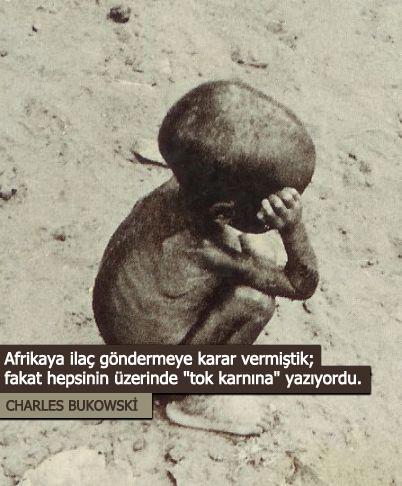
The poem with the same sharp impact on me, once again, is about the adults-to-be, as composed by Aziz Nesin:
I want to weep,
I want to weep to such extent, children
that no tear is left for you to shed
I want to stay hungry
I want to stay hungry to such extent, children
that there is no hunger for you to endure
I want to die,
I want to die to such extent, children
that there is no death left for you.
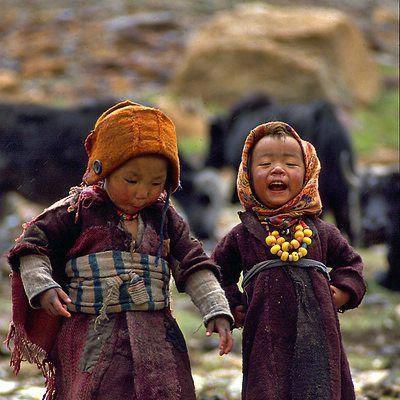
Also the link where I ran into my lyrical inspiration had an image associated with it and the intended message – as in the Bukowski statement – speaks for itself:
Not only risking but also actually deserving the brand as a hypocrite, I must say one thing out loud for once – breaking my own silence for whatever it is worth: Whether it is for a holiday or a regular day, the amount of food and beverages I buy or consume is excessive. Excessive to the point that many a times I could have walked out of my home, with my arms and hands filled with food I don’t need and taken them to others paining in hunger. Not to have anything edible shipped to a far place, though. For that step toward a larger scale is, to me, something that discourages many, forcing the mind to only note the immensity of such reach-out, and therefore, to abandon any and all desires to help altogether. I rather envision myself on the next feast-oriented occasion doing what my mother has done for that mother and her children, a mere total of four individuals: Be present in person while enabling one hot meal in an actual human-to-human exchange. I imagine the number increasing in affordable steps…
Keeping silent? By all means; that is, when we don’t have anything to say that is worth listening or our time. But not when we need a reminder to ourselves how breaking the silence may help us to stop for a brief moment in our whirl of self-indulgence to pander to those beyond our families, friends and acquaintances who are always well fed in the first place.
Filed under Reflections
Family and Friends: Loyalty and Freedom
Two quotes inspired me for today’s reflections. They come from two most unlikely sources when my association of their fame against the backlash of my nature is concerned. But then again, my aim for now is to dwell on negative judgments.
As were he to refer to our glorious time before my mother died – tragically, too early for most of us in the family, Mario Puzo states the following in his final novel: “The strength of a family, like the strength of an army, is in its loyalty to each other (The Family).” As soon as my mother’s death became a reality – one that we all preferred to deny for as long as possible, our family began to fall apart. In its facade and at its core. Never again to gain its indivisibility. My father’s wife did everything to keep the family together – a kind-hearted and understanding person, and tolerant to my father’s outbursts of dissatisfaction with his life after my mom. My brother’s wife, on the other hand, intensified her initially somewhat suppressed self-serving maneuvers to manipulate any and all happening in the family. I had not known our family history to include any break up among siblings. Until my own case happened. With her elaborate preparations.
Negative judgments: We give them. We are subjected to them. And I am no exception. Within our families, however, we would be best of, if we remained – in Puzo’s words, loyal to one another, hence strong. My brother chose to accept his wife’s stance on my divorce. I do and must, of course, involve myself in this fault, blame, judging dynamics but at this point only to the extent to note that I have given her the opportunity to attain material for her conduct: I had taken an erroneous step. Though, a grave mistake, the first and the only one since she had joined our family many decades ago. And, we had known each other from the age of eighteen on. My one mistake since. For which my daughter has forgiven me, having accepted me for who I had become during that time – a flawed individual at her worst (so far); nevertheless, she has not doubted the authentic I in me – the one she has known since the first aware moments in her life.
For my brother’s wife, my moment of internal crisis amidst a life-altering event – my divorce proceedings had become a fruitful ground to design, accessorize and materialize a judgment sentence on me. With her fulfillment of what may have been her intent all along, per my father’s prolonged conviction; namely, to demonstrate my lack of perfection to my brother – as he only perceived it about me. In order to be the only remaining purity in the family. In due process, I was stripped of my right to any privacy. Any attempt I made to preserve my individuality within the family court she had drawn against me, proved in vain. The re-presentation, or better, misrepresentation of my true self had already taken its successful place: In the judgment of my brother, their two sons and her aunt – all of whom always thought very highly of me, I had failed my entire life. Several years passed since. I still don’t believe to have recovered from the irreversible character assassination I thus suffered.
Exceptions aside, the irony is in the extent to which we lend our family members our trust in their non-judgmental acceptance of our lives, befitting but also poor decisions, our actions or the numerous aspects of ourselves. The immensely painful hit I gave myself through my experience of the serious misstep I have taken at the time was evident throughout my ordeal. My entire being was shaken at its core. Yet, I was not once asked by my family members of mention above to let go of my suffering. Nor was I ever told my life to be mine, with or without mistakes of any degree or nature.
In his article, Columbine: Parents Of a Killer, David Brooks writes about an e-mail the father of one of the shooters sent to him: “[…] the striking thing about his note was that while acknowledging the horrible crime his son had committed, Tom was still fiercely loyal toward him.” The same sense of loyalty did not come to me from my family. And, my judgment lapse was nothing to compare to a murder in the slightest.
A friend also heard – from me – my mistaken life step in each and every one of its details. With my then most private literary reference from Sue Monk Kidd: “A worker bee weighs less than a flower petal, but she can fly with a load heavier than her. But she only lives four or five weeks. Sometimes not feeling is the only way you can survive.” – Thinking that I hadn’t been as open as needed be, I also decided to reveal to her my other secret Kidd quote: “Someone who thinks death is the scariest thing doesn’t know a thing about life (The Secret Life of Bees).”
I was yearning for her understanding of my internal pain, needing to lend her insight into my state of helplessness – in the same manner I had tried to do with the mentioned members of my family. While only negative judgments came my way from them, my friend made sure that I heard her one message only: This is your life and I want you to be happy with it. No matter what you did or will do, I love you. I am your friend and will be on your side regardless of how or why you blame yourself for anything at anytime. Giving me the courage to talk to our other shared dear friends, she enabled me a self-empowering exit out of my own imprisonment of fault, blame, self-blame, and negative self-judgment. Not a single one of my friends ever left the seriously weakened me to my vulnerable self in my time of severe despair. My generous-hearted friend in whom I confided first, thus, gave me a life-size present at a time when I needed it with great desperation: unconditional loyalty.
At this moment in time, I find myself having to try hard to remain the unquestioning believer I used to be whenever the subject came to the unrivaled value of the family construct. It doesn’t take me even the smallest effort, however, to voice my conviction with regard to the vital importance of friends. Jim Morrison is quoted to have said the following on the subject:“A friend is someone who gives you total freedom to be yourself.” I am one of those utmost lucky for having experienced and continuing to experience such precious gift of life from all my friends.
May the Thanksigiving holiday surround you with loved ones who stand by you in unconditional loyalty, celebrating your freedom to be yourself as you delight in theirs.
Filed under Reflections
Bir Taneme (7 Ocak 2001)
Nereye gitti yaşam?
Nerede o sevenlerim?
Miniciktim. Biriciktim;
Göçtü hep beni iyi bilenlerim.
Pek zormuş büyümek!
Uzak kalmak sevenlerden,
dünya dertlerine direnmek,
aman beklemek gelip geçenlerden.
Kalp ağrısı
Yılların ağırlığı
Sevenlerin ayrılığı
Alın yazısı…
Gene de sen gül, Yavrum!
Yaşam öylesine güzel ki,
zorlukların yanında
çok ta hoş zevkler de var ki.
Yeter ki başın hep dik olsun!
Gözlerinde dolu dolu heyecan;
Seçtiğin yollar hep açık;
Sevdiklerin gercek dostlar olsun.
Filed under Reflections
A NaBloPoMo Writing Prompt
For the first time today, I am deriving my reflections from a cue at the site of NaBloPoMo (National Blog Posting Month), namely from that of Wednesday, February 22, 2012: “If you had to live with one member of your extended family for a year, who would it be?”
In complete frankness: The idea of any member of my extended family living with me for a year has never enticed me, neither have I ever pictured myself to be that individual. Even my imagination – a steady companion otherwise – fails me as far as the original scenario. So, I deviate from the actual prompt, leaving out from inclusion any extended branch in the familial tree and answer the question with an unhesitating shout: my daughter!
My love for my daughter has been unconditional before she was born – before I knew I was going to give birth to a girl and while I raised her. Now that we are in an adult-size mother-daughter relationship, that love is mutual and perhaps our strongest fort. It nourishes continuous respect for and uncompromising acceptance of the differences in our personalities, life choices, and tolerance and understanding for the steps we were mistaken in taking. “I am the wisest man alive, for I know one thing, and that is that I know nothing [,]” Plato concludes in his voluminous work on ethics and politics, The Republic. Putting to shame my genuine conviction with Plato’s claim when knowledge and wisdom are taken into consideration, I still have to insist to say it out loud: “I know one thing,” one thing for certain, and that is my love for my daughter.
And yes – had I not changed the original prompt to a call for factual narration, it still would have been my daughter about whom I would write as a response. There is, however, nothing conditional about my case: She has, indeed, been living with me. For over a year. Together with her husband.
Summer of 2011, their arrival date back in the U.S. to begin to live with me, has been the bearer of an oncoming difficult time for all of us but for my daughter, in particular. My son-in-law and I had our distinct differences from our initial reunion on, a fact we found out very soon after living through the first in the form of serious personal conflicts. When I think back at those first few weeks, I end up wishing against all factors of reality: namely, to be able to take back all my harsh reactions to anything he was about and stood for but also to silence myself before I uttered any hurtful words. I had been very protective of my long-term privacy, something I just wasn’t ready and willing to compromise, simply because he happened to be married to my One and Only.
While I was overjoyed because my daughter now was not only back in her home country but also was going to live close by, I overlooked the pain I created for her on account of my behavior toward her husband, the man she loves. Overly self-confident, convinced of my sophistication in matters of human interaction and in a variety of communication means, I forgot to notice. What he was going through in their initiative and efforts to settle in what was to him a foreign country, having left their secured lifestyle of multiple years back in Germany. In the heat of my concern for the change in my own life circumstances, I had abandoned my calm, my caring and gentle self, my mastery over my actions and speech. Today still, very long after my clashes with my son-in-law ceased and became a thing of the past, I am reminded of the following words of wisdom by the American author, Napoleon Hill: “Self-discipline begins with the mastery of your thoughts. If you don’t control what you think, you can’t control what you do. Simply, self-discipline enables you to think first and act afterward.”
Before this year ends, my daughter and my son-in-law will have moved out of my home. No longer due to the anxiety-and unease-ridden exchanges between my son-in-law and myself during our early encounter – an initiative both must have considered acting upon back then. But rather, happily, for another reason: To have what they can finally call their own four walls. With the exception of those hurtful few first weeks, I have given neither my daughter nor my son-in-law any reason to be unhappy, uneasy or anxious or to live through anguish in any form or size because of any acts or words on my behalf. For I – thankfully for all three of us – realized soon enough how to make peace with the differences in our personalities, life choices, mindsets and worldviews. Namely, by presenting unconditional respect, acceptance, understanding and tolerance, all gifts I enjoyed in my life thus far from and with my One and Only, to her One and Only.
The inquisitive prompt sought an answer in the conditional and should not remain unanswered: My One and Only’s One and Only.
Filed under Reflections
Inspired by “TOMORROW’S COLLEGE” of “American Radio Works”
Seeking some new insight into the most current deliberations on college-level teaching – my profession that spans over thirty-three years, I find Rethinking the Way College Students Are Taught, a Tomorrow’s College article by Emily Hanford, the Education Correspondent of American RadioWorks. I read it with laid-back interest. No sign of excitement in me whatsoever. No “Eureka” moment. One that I had been hoping to live one of these days. No further progress in sight. For, I have already gone through the techniques and methodologies she accentuates in her reflection on her interviews with two physics professors, one from a state university, the other, from a Ivy League college: Don’t lecture; resort to technology in class; get students involved in their learning process, instead. Besides, rethinking how to teach any of my Liberal Arts classes – all in German at the moment – has been a conscious act for me before every new semester. I must keep looking, then. Perhaps before retirement – still a far point of destination for me, I may invent the magical solution for all our ills at college-level instruction. Regardless of the field of study. And for students and non-students alike.
But first, I shall remain in the moment’s reality.
Hanford’s description of a “typical scene” for the onset of a class triggers in the brain the very vivid and very recent memory of my own experience: students are sleepy, chatty, laughing and finding their seats; or, they have found their seats and are sleepy, chatty and laughing. “Class begins with a big ‘shhhh’ from the instructor,” she writes. Mine is an “shhhh”-less alarm. My entry into each classroom is of extra-cautious nature. As a sign of my thankful welcome to their livelihood: if their energy level is high enough to chat with one another in laughter while being able to find seats to their sleep-deprived bodies, such behavior promises to me their active involvement in the upcoming subject matter (although, too often, the promise faces emptiness). To signal we are starting regardless of their chatter and laughter, I resort to the German words of “hospital and library” in the same breath – two places where one must keep silent under universal understanding.
The “shhhh”-less alarm of mine works every time. They look up, at me, most of them, smiling. On my more patient days, I look around the classroom, with a slow and calm movement of my head with no frown in sight on my face, speaking no word. My complete silence gets the attention. But what happens, or what does not happen, after class begins, is wherein the dilemma lies. To what extent does learning takes place in reality? Such is the open-ended question. Where the following comes in to play, however, is not: my alertness, willingness, readiness, creativity, innovativeness and enthusiasm to meet their need for a maximum learning outcome for each of them (that is, for whoever is receptive).
Hanford announces another well-known fact: “Research conducted over the past few decades shows it’s impossible for students to take in and process all the information presented during a typical lecture, and yet this is one of the primary ways college students are taught, particularly in introductory courses. It’s a tradition going back thousands of years.” As a personal trait, I refuse to follow traditions in the strict or lose sense at any rate. I haven’t found much use in them. My rejection of them gains on passion, when the core element of my extensive career, the precious teaching and learning exchange is concerned. Each of my students is an individual and therefore, a learner with a vast variety of skills, comfort level, study habits, time management practice and response readiness and speed. All of which characteristics are not a carbon-copy of their peers. Each of them deserves to have exposure on a regular basis to task-based practices and assignments through which s/he – on an individual level – will have the opportunity to advance upon the proficiency toward the material taught. Without having to face a confrontation with lectures that rely on standardizing all vital differences between each of the learners in that captive audience. “DON’T LECTURE ME,” the article’s headline, is a plea I remember raising – however silently – to all my professors during my university studies. The yellowed papers almost in no longer glueable pieces of one professor, in particular, still are notable in my temporal lobes today. Along with his slow-motion efforts to read out of his writings – most likely beyond de-codable even to him – in order to copy whatever valuable information was left on them from those pitiful, ancient-old sources onto the one blackboard we had. All the while expecting us to keep full silence and looking at us only to check if we were still taking notes.
With or without such eye-opening experiences, rethinking how I teach my college students is not a difficult undertaking for me. I have gone through such contemplations so many times, implementing all that I had rethought as a result, learning and re-learning on behalf of my students. I will do so again. There is, however, a hit I have to take. As Hanford concludes, “[c]hange is slow in the academy, and professors tend to be rewarded for focusing on their research, often at the expense of their teaching.”
I, for one, haven’t advanced upon the research component of my professional existence in years. I won’t be advancing on that platform for years to come. I have been teaching only. Not because there has been any tangible reward in the academy. There simply is no room for me to do justice to both areas. For our current higher education construct does not yet allow a balance between the demands on time, energy and concentration commitment for teaching and research in any reasonable terms. There, thus, had to be a sacrifice. But, it wasn’t going to be my teaching. It still isn’t.
Please note: Cited links are also available in my site’s Blogroll list.
Filed under Reflections
Changes
Welcome back, dear reader! True: this Wednesday post is “Filed under ‘Sunday Reflections’.” True: it is still only Wednesday. The day of the week when I published a new post here, since the late night I created this blog site months ago. Now, I have some changes for you (other than in the site’s immediate appearance):
As before, I will continue to meet with you weekly over a new writing but I will do so on the weekend instead of mid-week. I hope you will like the timing as much as I. In a hopeful attempt at easier navigation, the menu titles along with the posts in each have also undergone modification. It is my weekly posts, however, that will reflect the major transformation. While in the past they had consisted of my literary work at large, my non-literary writings will serve for their content from this Sunday on. I look forward to your visit this weekend, and beyond when you may decide to stop by again.
Filed under Reflections
 hülyaswritings