Tag Archives: Inner Child Press International

“nomads”

so, very little is known about your lives
is the professional claim in our times
the so-called “modern-day” jest
won’t be as stingy about us i suspect
we surely must self-glorify in retrospect

i don’t doubt what’s said about you today
when i look at our conditions in dismay
the continent you were “among the first”
to inhabitate is yelped to be the only greatest
just when i darn the nth rave then comes the latest

your surviving ancestors may 9,000 years later
discover or make for this laughing stock a grater
for it direly needs the ultimate fine-tuning of all times
our predicament should after all not stay as a secret
maybe they can distill this pickle oh so terribly acrid

you were a wandering and gathering lot i heard
we on the other hand are an incessantly scattering herd
you clothed yourselves with the skin of your hunt
and eaten plants to stay alive while we go the other way
we are the meals and nature are soon to meet its d-day

© hülya n. yılmaz, May 14, 2018

[Published by Inner Child Press International in the June issue of the fifth volume of The Year of the Poet]

1 Comment

Filed under Poetry

“inventions, discoveries and donations”

inventions

too many of us are offended
become demoralized and uneasy
when we are reminded of “the other”
of “its” masteries, in particular
while we keep on indulging
in “its” stellar gifts to “the self”

dissatisfaction

impatience
dejection

blame the aware few . . .

why stir up history
as it was written
as it is taught
for “the self”
by “the self”

why pull the brakes ever
of our speeding time-shuttle
to acknowledge “the other” at last
with “its” long-overdue recognition
contemplating thus our own human blood

God forbid!

if we so did . . .

we then might realize
for a passing moment at least
how abundantly the “self” benefited
for centuries not for a mere several years
from “the other” and “its” still-shedding labor-tears . . .

discoveries

our lives would not have been the same
had the “other” not invented or discovered
nor had left intact for the misuse by “the self”
“its” surname bleeding still
taken from “its” sweat and blood
together with all else that to this day does remain

donations

un-written . . .

yes

the subject is Sumerians
of Ancient Mesopotamia
“the cradle of civilization”

how often do we come across
the oft-cited term to belong
to a lobbying cultural entity
as if it were for it to own

no surprises there!

another always seems to bear
the highest octave to raise
so it gets the praise
our history books bear witness

yet those writes
suffer from a mono-lithic lens
thus we reserve the honor
for one or the other
as long as it is not

by no means!

“the other”

furthermore

we cheer from the sidelines
turning into a music buff of some sort

though we know
deep down we know

blame the aware few . . .

why alter a make-belief
a working bed-time story
with all its esteemed fake glory

the invention of
Agriculture
intact with its Plow
and System of Irrigation
the Wheel
the Chariot
the Sailboat
the System of Time
the Concept of Astrology
as well as that of Astronomy
the Map
Mathematics
Urbanization
the Cuneiform
the First Form of Writing

yes

the First Form of Writing

but . . .

our history books
continue to claim
Nay! Oh, nay!
The Sumerians?
Of Ancient Mesopotamia?
The Cradle of Civilization?
Nay!
No way!

. . .

feel free to fill in the blanks
with names that are yet to make the ranks
out of the abyss of intentional omission
for their past and present donation
after all should that not be our mission

unless of course we seek our due commission

blame the aware few . . .

© hülya n. yılmaz, April 18, 2018

[Published by Inner Child Press International in the May issue of the fifth volume of The Year of the Poet]
2 Comments

Filed under Poetry

“Indian People Are Still Here”

“Indian people are still here,”
Otis Halfmoon of the Nez Percѐ tribe maintains
and adds: “We are not going away. It is time that
The newcomers to this country started paying
Proper respect to the elder status of the first nations.”

Chief Joseph: “Every animal knows more than you do. White men have too many chiefs. Learn how to talk, Then learn how to teach.”

a nation whose population
marked its intent to live in peace
yet was forced to dress in war-wear
for the U.S. government
began to shoo it away
way down below
onto reservations

in the words of the reservation doctor
he died of a broken heart
his countless appeals
to federal authorities
had after all
failed

“I am tired of fighting . . . from where
The sun now stands. I will fight no more”,
uttered by In-mut-too-yah-lat-lat,
“Thunder coming up over the land from the water”,
Or, “Chief Joseph” as he now is known to us,
the still proudly ignorant populace
that erodes more of his land
night by each dark night
day by each darker day

let us recall the times when we have died . . .
a death by a broken heart

© hülya n. yılmaz, March 18, 2018

[Published by Inner Child Press International in the April issue of the fifth volume of The Year of the Poet]

2 Comments

Filed under Poetry

“Nimi’ipuu”

the French
named them “Pierced Nose”
the ignorant
happened to find it befitting
such a limiting tag
the signaled practice however
is known not to have been wide-spread at all
othering the other “Self”
what’s new?

rivers have understood them
the lower Snake River
the Clearwater
the Salmon
as have streams and high plateaus
but also nature’s other gifts of abundance
berries roots a wide range of game
to which they would ask for forgiveness
for having had to kill for survival
while the French and non-French alike
continued their Nez Percѐ-butchery
among other acts of carnage
to pierce noses . . .
perhaps

horses were discovered in the 18th century
by this warlike-growing North American tribe
to its peoples alone does the gift of breeding belong
of the largest horse herds in the continent that is
including the distinctively colored Appaloosa
a most popular breed in today’s U.S.A.

looking at them with robotic eyes . . .
one should not neglect an add-on to this tale
what was (or may be still) their linguistic grouping?
we had better not forget our manners!
encyclopedias deliver detailed data on “Sahaptin”
even add this tongue is also called
Shahaptin and Sahaptian

imagine

if only we had this insight before
we would have . . .

© hülya n. yılmaz, March 15, 2018

[Published by Inner Child Press International in the April issue of the fifth volume of The Year of the Poet]

3 Comments

Filed under Poetry

“what else is left to do?”

what else is left to do
but to bow in highest respect
before the pens of a power
that overrules the brutality of the
segregationist
colonialist
chauvinist
ethnicist
sexist
racist
surpassing time and space
as only the unwavering ink can do

now is the only time
and here, the only place
where we must and shall
unconditionally embrace
for one loss from our unity in diversity
is a cause for an irreversible tragedy
that will appoint us with no delay
to the expiry of our humanity

© hülya n. yılmaz, February 18, 2018

[Published by Inner Child Press International in the March issue of the fifth volume of The Year of the Poet]

4 Comments

Filed under Poetry

“a coincidence”

“Guyana Pastoral” kept calling me
from a place i dare not describe
i had no knowledge of the language
it was dubbed as Guyanese Creole
i still have no knowledge of the language
but assume to understand some words in it
it was the composer i just had to “get” anyway
and i believe i now have
Guyana’s Ambassador-at-Large
David Dabydeen
an explorer of the history of Guyana,
UNESCO’s Executive Board member
presenter of “The Forgotten Colony”

a mere sand particle at the sea colonies . . .

the owner of the incredible response
to J.M.W. Turner’s “Slave Ship”-painting
Turner’s depiction of African slaves in chains
being thrown overboard . . .
Dabydeen’s contemplation
on the ‘submerged body of a drowned slave
in the foreground’ of the piece,
his fantasy- and history-melding
upon the slave’s portrayal
his compelling act of reclaiming
and redeeming of the past
amid the shadows of his insights into
and studies of “the horrors of slavery and
colonization”, under the ever-so-thickening
clouds that carry on the darkest fame of
European barbarians, among which he ‘stages’
the migrant predicament
stating it as it is in an interview:

I’m inclined to think that Britain has
heavily depended on us for its material
and cultural development. The tribe had
an important say and influence in the
[British]development. You can’t be
a Guyanese without being a Brit and
you can’t be a Brit without being a
Guyanese, or a Caribbean.

recognition came along, it indeed came along
for Dabydeen would not leave any of it alone
along his steadfast extraordinary way
he helped the British develop some more
for he wanted the cast over the bloodied pools
under the blood-soaked beds no more
he helped the world develop some more
so, he co-edited a monumental how-to-book
for the walking dead of colonialist barbarisms-at-large
the Oxford Companion to
Black British History
which went down to history
as “a magisterial excavation of Black Britain”

one award after another accompanied Dabydeen
not merely for his editing work but rather as
a poet –the winner of the Commonwealth Poetry Prize
a masterful novelist
a model scholar
a literary-icon-educator
the Director of the Centre for Caribbean Studies
and Professor at the Centre
for British Comparative Cultural Studies
at the University of Warwick
and much more . . .

a coincidence?

I think not!

my discovery
of the Highly Esteemed David Dabydeen
was meant to be

for it has materialized
at a time of an utterly-trying
professional hardship of mine
not to exclude all those contemplations
on the value of poetry to me
a life-ring in a turbulent sea
with a nearby-view of the long-lost years
to no longer be
David rescued me
a professor passionate in teaching
a heavily-faded scholar of some merit
however depressed or self-oppressed
a struggling writer of fiction
a poet starving for self-attention
with much to tell and speak of yet
including the ‘migrant condition’
though not of Black History alone
nor purely of David’s “Slave Song”

besides
i wouldn’t know where to begin
and doing disservice to any gems
is not cannot will not be mine to claim

so,
it is my own path that i will follow
believe me there is significant sorrow
in that which i am able to pierce
through at least one lightless shadow

so,
i shall proceed
whenever wherever the ground is opportune
of course, always all ways
with fiery thanks from the soul
to that magical tongue
called the Guyanese Creole

© hülya n. yılmaz, February 18, 2018

[Published by Inner Child Press International in the March issue of the fifth volume of The Year of the Poet]


2 Comments

Filed under Poetry

“torn”

how can you even begin to understand
when all you ever saw was a callous-hearted photograph
of a savagely soul-emptied land
or grasp the devoted dedicated commitment of its people
to their justly attained long-labored traditions and customs
cradled within the tenderly nurtured gentle realm
of their age-old civilization?

how can you even begin to conceive
where these precious fellow-souls
gather the countless pieces of their insides
after witnessing the slaughter of their babies
or what happens to that infant-innocence
if it survives the annihilation of its elderly
long enough to avow that it will further survive?

why don’t you look around
can you really not see
the multitudes of suffering abound?

torn inside and out
you still just go about . . .

“Business as usual” rules, you say?
better yet, the passé overrules
any likely change in our busy-ness
and stays put on its mighty swing set
to carefreely sway its mundane existence away
from the highest high of a ceiling
to the deepest hole in the ground

© hülya n. yılmaz, June 31, 2018

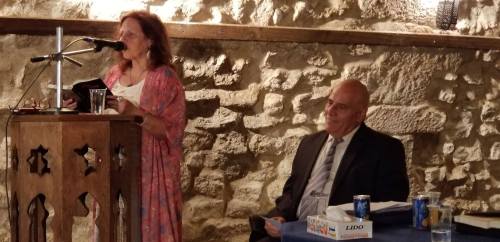
This poem was my contribution to Palestine. A Conscious Poetic Offering, an anthology of global endeavors, compiled by Gail Weston Shazor, the Director of Anthologies at Inner Child Press International, soon to be published by Inner Child Press International. Nizar Sartawi, the Director of International Relations at Inner Child Press International -educator, poet, literary translator shown in the picture, has kindly translated the poems I have read on various occasions in or near Amman, Jordan into Arabic. My special thanks go in abundance to all these much-cherished individuals.

37955595_10215001084933583_8035208268294914048_o

[Photo Credit: William S. Peters Sr.]

2 Comments

Filed under Poetry, Reflections

One Day Later . . . from Amman

To connect to the Internet has been somewhat of a challenge here, in Amman, where I am deliriously enjoying an incredible stay for about a month. So, my Wednesday post comes to you belated, dear reader. Bear with me not only as far as this delay but also when the content is concerned, as I am re-visiting a poem I have shared with you before. There is a difference this time, however, and that is where else I have presented this piece of my poetry: At the Jarash Festival of Culture and Arts in Jordan. In the future, I hope to write much more about my wonder-filled experiences in this gorgeous world region. For the time being, I will suffice to let you in on a secret only: My reading of the poem below on two different occasions has met a gracious acceptance, for which I was and continue to be most thankful. I have had the privilege to recite my poem first in Al-Karak, Jordan for The Jarash Festival of Culture and Arts and then, in Amman for the Orthodox Club. While I read “routines” in English, Nizar Sartawi, our incredible host in Amman, has in his beautiful voice read it in Arabic. Mr. Sartawi, educator, is a prolific poet in English and Arabic and a prominent literary translator. With this post, I am extending my heartfelt thanks not only to dearest Nizar but also to his graceful wife, Zulfa, both of who embraced us as their family in their gorgeous home in Amman. An eternal shout of “Sukran” to you, dearest Zulfa! An eternal “Sukran” to you, dearest Nizar! 

routines

i wake up to just another day
and am soon on my way to work
a school bus waits at the curbside
its hugs, ready for the bubbly children
a parent or a grandparent is always there
seeing their babies off to their safe returns

i think back and reminisce in peace
about my own child’s schooling ease . . .

children get born also
in other parts of our world of course!
children are cherished also
in other parts of our world of course!
children are loved also
in other parts of our world of course!

some struggle to stay alive
some can only try to struggle
death finds them when too young

though it does not routinely arrive
with the intent of a personal kill
they are often left behind
without a caring guardian

for the rest of their butchered lives
they await their pre-determined fate

the notoriously grim reaper has for long
been contracted by psychopaths after all
from in- as well as outside their nations of birth

in those dispensable long-forgotten geographies
a school bus might succeed in a lucky appearance
in “neutral” zones or at a “no dispute-border” for instance
as a rare sight for sure
a notable source of pride
but only until the moment
its door begins to open wide
either to gulp down tiny corpses
or to spit them out bone by bone

(c) hülya n. yılmaz, August 2, 2017

37955595_10215001084933583_8035208268294914048_o

[Photo Credit: William S. Peters Sr.]

2 Comments

Filed under Impulses, Poetry, Reflections

a poem-trilogy

In recent times, I have been experimenting with my poems as far as their thematic bond whenever a demand was in place. The year of 2018 alone has now seen my poetry in connection with one another. The latest example are my three poems below, all of which will appear in the July issue of the international anthology, The Year of the Poet made available in print to readers every month. This month’s focal civilization was “Oceania”, and the following poetic narrative is what dictated my contribution:

entitled, 1

does the name “Cook” James Cook
as in Captain James Cook that is
sound familiar to you
no, you say?
how can that be!
he has a monument in his name you see
for the monumental service he has done in 1774
he proudly did vandalize torture butcher and colonize
the natives of Vanuatu Islands of 500 BCE
whitened them ever so graciously with a new name
The New Hebrides . . .

you get it of course
there was nothing “new” about the host-land
up until that year ambushed it mercilessly
then . . . there were no more
the same as they were before

the white legacy

isn’t it just grand?

entitled, 2

Kudos to the British!
they worked also 19th century
to their advantage
they took home the bounty
yet once again

the poor unknowing Spanish!
a rushed glimpse of the Tuvalu islands
did not suffice to make them stay

Alas!

they thus failed to discover
the land’s richness in phosphate
mined by the islanders
profits fed-exed to the Commonwealth

entitled, 3

there once was an island called “Nauru”
1,400 people lived on it in peace
they spoke their native tongue
they had their native culture
phosphate was in abundance . . .

the year was 1843 then

45 years later

only 900 survived

together with their phosphate

their language and culture?
out the window they went . . .

© hülya n yılmaz, June 15, 2018

~ ~ ~ ~ ~ ~ ~ ~ ~ ~ ~ ~ ~ ~ ~ ~ ~ ~ ~ ~

Related Links/Readings:

Vanuatu.History.People.Location
Tuvalu.Culture.History.People.Facts
Nauru.Land.People.Culture.Economy.Society.History


Leave a comment

Filed under Poetry, Reflections

*”instead of . . .”

i surprised him

the second he spotted me behind his mommy
his little darling body became a dance all by itself
his forever-smiling face made room for giggles
many many giggles

then joyous ‘come on, grandma!’s

hand in hand
eyes locked on mine
my little enormous sunshine!

‘you come to anne car’
ending in 1/3 of a question mark
with my yes already housed in his brightly shining heart

leaving his pre-school . . .
amid the two grown women’s chatter
as untainted as any voice can ever be:
“I love you, grandma!”

i love him so
his little sister too
that each of my exchanges with them
takes my breath away

and i think . . .
together we all get to breathe again
laughing
crying
eating
drinking
sleeping
celebrating
loving and being loved again

yet on the many other ends of our world
because of a few power-fed sick minds
and their equally loveless bribe-filled grinds
children die
die die die

and die again

*This poem was posted here once before. When I recently got to see my grandson and my granddaughter after a long period of time had passed, I could not help myself but re-visit that most memorable day.

From my newest book of poetry:
Aflame. Memoirs in Verse. Inner Child Press (August 2, 2017)
Available at inner child press
Also available at inner child press are the following:
Trance (December 12, 2013), my tri-lingual poetry book with my own translations between English, German and Turkish, and
An Aegean Breeze of Peace, a book of poetry that I have co-authored with
Demetrios Trifiatis (October 12, 2015)

3 Comments

Filed under Poetry, Reflections